Showing posts with label SAP. Show all posts

Thursday, July 7, 2016

With an "ERP for the CIO" product, uGovernIT challenges the "startups only pursue the consumer market" stereotype


A lot of the glamor in the technology world shines on the fabled Silicon Valley startups. You know, brilliant young people, huddling over their laptops coding night and day, and coming up with Snapchat. Or Instagram. Or Angry Birds. What is the common denominator for that startup world? It's directed at the consumer market, and most likely, to the goal of being acquired by a bigger company for a LOT of money.

What do they have in common with the enterprise CIO, and the needs he or she faces every day? And why does it seems as though most of that precocious startup talent is focused on the consumer space?

That is a story in itself, and I'll tell it through the example of an exception to the "startups are only interested in consumers" idea.

 uGovernIT is an ingenious startup, based in greater Los Angeles.  It challenges that conventional startup thinking by aiming directly at the pain points faced by C-level executives in the enterprise. Even more specifically, they are going after the midmarket segment of the SMB space.

uGovernIT is "ERP for the CIO," an integrated suite of IT management functions delivered through a web browser. Founder Subbu Murthy sees an opportunity to bring the same kind of disruption to enterprise applications that consumerization of the enterprise has brought to the workplace.
uGovernIT founder Subbu Murthy

Although uGovernIT works with larger enterprise deployments, the focus is on the mid-market--a standalone product that is completely functional in a smaller enterprise even without back-end systems in place for functions like project management, portfolio management, and resource allocation.  In common with consumerization of the enterprise products, uGovernIT is quick to deploy and does not require extensive configuration or infrastructure investment.  Another powerful lesson uGovernIT takes from consumerization: you can drive quicker time-to-value in business IT by simplifying and standardizing processes while allowing some customization at the user level.

I can bring personal experience to bear on this commentary, too. As I've written in previous posts, since moving to the bay area in 2013, I have worked in the retail space at both a national chain of about 100 stores and at a much smaller lifestyle operation with a website, a couple of retail locations, and 2 restaurants. In my stealth retail analyst role in each of them, I was astonished to see the difference in the IT approach compared with a Fortune 500 company. Specific expertise is rare, ability to innovate is almost nil because so many resources are devoted to keeping legacy tech going, and purchase decisions are made by people with almost no knowledge of the bigger technology world.

If any marketplace is ripe for disruption, it's the midmarket and its beleaguered CIO. Surely a web-delivered app that gives smaller companies low-cost access to enterprise-grade services like workflow, analytics, and project/resource management would be a huge draw.  But it's not as simple as "build it and they will come." 

I was introduced to Murthy by a colleague at a major research firm; the uGovernIT startup is not itself large enough, or the recipient of enough analyst coverage, to warrant coverage yet by IDC, Gartner, or Forrester. But my analyst colleague still saw the value in Murthy's work, and suggested that he and I talk.  I've spent several hours in conversation with with Murthy and his CIO John Grunzweig.  uGovernIT is a fine offering with a clearly defined market.  It's definitely a sound business model.  And as detailed in part 2 of this report, it reflects some important emerging technology ideas you've read about on Infrics.com for several years.

In e-mail exchanges, I had the following conversation with Murthy:

Infrics: Tell me about your decision to develop uGovernIT. Why this product? Why this market?

"As a CIO, I felt that CIOs did not walk the talk. On one hand, they would be recommending analytics and business intelligence, but they were not practicing it. The reason was not that they were not smart, but they did not have the tools that they could afford. The mid market could not afford the kind of tools their big brother could. So uGovernIT was formed to provide a one stop for all tools needed to manage IT."


--Your product is live and your team is dealing with sales and with clients in the field. What lessons have you learned about the decision to develop for SMBs instead of, say, a potentially lucrative mobile app for the consumer space?
"Perhaps, my motivation was driven by my experience as a CIO in mid-market firms. Money is a by-product and not a goal in itself. So when I saw a need and most product firms were only focused on the big companies, I decide to invest and develop a tool that was easy to use but with great utility."

--Are clients revealing new markets to you based on the way they respond to the uGovernIT "ERP for CIOs" concept?
"That is a starting to happen. Our entry into the construction vertical is derived from the need for dynamic resource management that connected the resource supply to demands."

--You mentioned to me once that it's not just developers who seem fixated on the consumer market, but that the venture capital community has been challenging for enterprise-directed startups. What message would you like the V.C. world to hear about enterprise products?
"Great question. My message to VCs is consumer products have pizzazz and the lure, but enterprise products are critical. The shift from just being an Analog enterprise to Digital is well on the way. The case study shared by CIO Magazine (November 1, 2015 Issue) provides insights into how IOT (Internet of Things), analytics and the mobile platform have enabled Michael Nilles to embark on a journey where technology and core business of Schindler (elevators) are inseparable. The existing enterprise systems need to be disrupted with totally different systems. For example, action centric systems will replace data centric ERP. I feel what we are doing to IT management, there will be disruptive technologies that will render SAP, Oracle expensive and irrelevant."


--After I spent a couple of hours in a product demo, it seemed to me that the sweet spot for you in the market is a firm big enough to need ERP-like functions, but not so large that they have already invested in spot solutions. As a former CIO yourself, will you talk a little about the integrated approach you've chosen? Do you see your offering as more of a "one integrated solution" or as an integrated front end for systems or business processes that companies may already have in place?
You are right on the money. While our tool is marketed as a one-stop complete solution, we can be the front end tying things together for firms that do not want to change transactional systems. For mid-market with a solution, the one integrated solution probably applies, but for larger firms they want to probably retain the point solutions, therefore, the integrated platform which can tie things together is a good metaphor.

--Talk to me about the architecture of uGovernIT. I'm specifically thinking about the use of a well-liked backend in Microsoft's SharePoint as a starting point. What are the implications for you as a startup, and for your customers as a "you already trust this program" sales point. 

While our platform supports multi-tenant models, we felt that most mid-market companies are tied into Office 365 and SharePoint. This is why decided on the SharePoint approach. That said, we only use SharePoint for content management and access, but we have our own workflow and analytics engine.

--I asked earlier about your message to V.C.s What insights do you have for those considering developing for the enterprise market?
My advice to entrepreneurs considering the Enterprise market is three fold:

1. Know your market. I was a CIO for several years before I could embark on this product.

2. Have a target customer. I had three adopters even before I wrote a single line of code.

3. Have good mentors. I had over 20 CIOs who guided me.

In part 2 of this report, we'll examine what uGovernIT does, and how it aligns with classic Infrics.com themes like stateless computing and complexity management.




Thursday, December 1, 2011

What happens when users won't play "Mother, May I" with IT?

--part 2 of the "Big Ideas" conversation with Podio's Ryan Nichols


Last week, Infrics.com featured Ryan Nichols, formerly of SAPs strategy office, formerly of cloud integrator Appirio, and now a vice president for applications at startup Podio.com.  Nichols has been on the front lines of the three current faces of enterprise software: big legacy ERP, cloud platforms and applications, and now with Podio, end-user empowerment, and the rise of "citizen programmers" who can purpose-build their own applications without the presence of any IT department.  Here is the article about Podio's approach:  "The two-minute, user-created app; how Podio leads the era of you."

Life in the C-suite is never easy, but right this minute CIOs and the CEOs of their companies face daunting tech challenges: on the one hand, there are enormous pressures to be more agile, yet still deal with legacy technology installations, execute on existing efforts, and manage costs; on the other, a loud and increasingly empowered base of business units and end-users who are mad as hell at IT for not keeping pace with their tech experiences as consumers--and who now have the power to source their own tech solutions without any input from the corporate IT department. Add to this the simple fact that a larger corporation has built-in inertia and change resistance that render it like a big steamship approaching icebergs; you can see the danger, but avoiding it is slow at best.

"Shadow IT," or "Rogue IT" is big enough to elicit this article from CIO.com last summer, "How to Keep Rogue Cloud Software from Making IT Irrelevant", and a cover story on the issue in September.  Research studies suggest that corporate IT departments significantly underestimate the extent to which users in their own businesses are "doing it for themselves."

Since Nichols has had a presence across many facets of enterprise IT, and now is with a company designed specifically to put tech development into the hands of end users, we talked about the whole "era of you" idea, which led to this discussion:

Don:  This whole social, consumerization, all this is moving toward a dramatically greater degree of personalization for each of us as an individual and as a worker, but also moving the power to choose, implement, and get value from technology much closer to the people who use it every day. Taking IT out of the picture as the people without whom you can’t do your job. One reason Podio is especially fascinating to me is that it seems to facilitate that “era of you” concept--that you do it for yourself.

Nichols:  that’s exactly what we’re going after. The first wave of platform-as-a-service has been very enabling for IT, where IT can build apps without having to worry about infrastructure...but I have to say, at my last company we ran our entire business on salesforce and force.com, and I never once built an app of my own. I took what IT gave me and then when I needed to get something done, I turned to a Google spreadsheet. That’s broken, there’s this huge in-between space where all the time I’d be trying to manage something, trying to get something done and getting it done in e-mail and documents--there’s a more productive way to do it.

Don:  You play “mother may I” with IT.

Nichols:   Yeah, and that’s broken too. It’s in nobody’s interest for me to do that. But these are the tools that I’m given, so that’s what I make do with. There should be a better way.

Don:  If I’m a CIO, and let’s say I’m at a company that’s three or five billion dollars a year, and I’m seeing this promise, but I’ve got huge volumes of data and thousands and thousands of employees, and regulatory compliance, and my legal department...what’s your advice to a CIO like that? Podio might be part of their picture, but they understand on some level that this is all broken, too. It’s a common refrain among a lot of analysts that enterprise IT is broken.

You represent kind of the extreme of ultra-agile user empowerment. As someone who’s out there scouting in that area, what’s your message to big legacy-bound CIOs?

RN: First of all, I have to communicate, they’re in a tough spot. There’s no easy answer for enterprise CIOs because it’s not a question of whether they’re going to empower their employees or not. Their employees ARE empowered. They are doing what they need to do to get their jobs done and to the extent that IT helps them with that, great, but when that stops, they’re ALREADY doing the rest themselves. And whether they’re doing that by using existing tools in unintended ways--e-mailing spreadsheets of very confidential information around--or whether they’re using unauthorized tools like the plethora of consumer-grade apps that we see being adopted like crazy in the enterprise.

So it’s happening anyway. It’s ITs choice to get behind what’s already happening and put in some degree of combination of control and support.  If you are participating in that and engaging in that dialogue in as secure a way as possible, then that’s a far better outcome for your enterprise than either pretending like it’s not happening, putting on the blinders, or putting up a fence and saying “you’re not going to break out of this fence,” because that’s just not the reality.  This is happening anyway and I think ITs only choice is to embrace and extend: accepting the fact that, yep, people are going to be using their own devices. Let’s embrace that and figure out how to make that secure.  They are going to be adopting all the software tools that are available to them on the internet to get their job done.  Let’s figure out how to do that in a way where they’re using SSL to access them, just to give an example.

I think those are going to be the tradeoffs that enterprise IT is going to have to make.

Don: That sounds like it might be part of your own value proposition to Podio, because you’ve been on the other side. With a career at SAP, that’s about as un-Podio as you can get and still talk about technology.

RN: (laughs) I think that’s true. You know, the reality is that enterprise IT is going to be looking to different vendors for different things, and I think one of my learnings from the time I spent at SAP is that SAP’s enterprise customers want SAP to be the system that doesn’t change, be the system that they don’t need to touch more than once every five years. That’s what they want SAP to stay, which is why it’s so tough for SAP to innovate and change because at the end of the day, their customers don’t really want them to.

Don:  As you know, except for the cost of licensing and maintenance, probably the biggest single complaint with that company is UI (user interface.)  It has been since I’ve ever known of SAP. Podio must care very very deeply about UI because it’s just you and me out there making things.

RN: It’s one of the core values in the company, and one of the reasons I think we really benefit from our headquarters in Copenhagen. There’s just something in the DNA of Podio around beautiful, simple, clean design. It’s the only choice. If something’s complex, if it’s cluttered, if it’s wrong, it doesn’t make it into the product. It helps being able to start with a clean sheet of paper; even systems that have started five years ago, ten years ago, are burdened with a usability legacy that Podio isn’t burdened with.

When you’re able to start fresh and build something that’s built to support this type of work, you can make it beautiful and that’s absolutely what we aim to do.

Don: It’s funny to think of salesforce.com as being the slower alternative.

RN: Salesforce has a really nice problem of being dragged upmarket and embraced by IT and embraced by IT at larger and larger companies. And that’s great for salesforce, it’s good for their business. I think that it does leave space for a lighter weight way of doing things. This is a natural trajectory of solutions to be dragged up, and that creates a space underneath for a new generation of software with even subtle architecture shifts that you have to bake in from the beginning."

In another part of our conversation, Nichols and I talked about the challenge a company like Podio might present to a CIO, ways to think of that as an advantage instead, and how enterprise software may soon be created and shared via social means--how tech-enabled community may enter the enterprise equation in new ways:

Don: Since I used to wear a corporate IT buyer’s hat, I can say to Podio, “you’re the gateway drug for shadow IT, and you’re going to cause me a huge headache when all these user-developed apps start hitting my enterprise.” How do you respond to that idea?

RN: I would argue that you’d much rather have those things in Podio, where we have centralized administration and you can control the users who have access to these different spaces than where they are today, which is on Excel spreadsheets that get forwarded to who knows whom and posted who knows where, and saved in dropbox.

Don, So if I take off my corporate hat and become the Podio salesman, I say “no, we’re the gateway drug that lets you say yes to your users.” Is that the value proposition?

RN. That’s exactly right. And over time, there’s a lot more that Podio can do to empower IT to be even more supportive and involved in this process. We’re early in that.

Don: If I’m an SMB or a startup, and I’ve got a green field, this sounds extraordinarily attractive, but what if I've got legacy apps in my enterprise and I still want to take advantage of the agility and user empowerment that Podio promises?

RN: I sometimes draw a pyramid; companies that are bigger use Podio in different ways than companies that are smaller. Companies that are smaller use Podio for a broader variety of things because they don’t have established systems. Small companies use us as a CRM system, which, even a 500-person company would struggle to use Podio as the customer master system of record, it’s not really built for that. But for a smaller team it works great.

For larger teams, we have 500 person teams using Podio all the time for project management, event management, those sort of use cases, where it’s not the system of record, it’s a situational app for this project, for this event.

You can bring data into Podio in a couple of different ways, which is helpful if you have an existing system, and want to use Podio as the social layer, the integration layer. We built out integrations with a lot of systems that our small business customers use, like Freshbooks and Zendesk for ticket management. We have a number of customers who use Zendesk for their ticket management, but when they want to have a discussion around a particular ticket--how is this going to translate into our product roadmap--they take that into Podio, and Podio is kind of the social layer around the Zendesk ticket. The (Podio) apps are built up around that data that comes in from Zendesk.

We have a handful of those integrations today, that’s an area that we’re growing in, and that actually comes back to your earlier question about the developer community. I spend most of my time talking about these business-person developers. That’s the second half of our developer community -- the ecosystem of SaaS applications that we’d love to integrate with Podio, so that Podio can be that extensibility layer. The easiest way to build an app to extend Zendesk should be Podio, right, the easiest way to extend Freshbooks should be Podio.

We have a couple of those early proofs of concepts, but that’s the other area that I’m looking to grow our app community. That’s a more commercial aspect of our app ecosystem. Today our app store is primarily businesspeople building apps to share them to support each other and to swap best practices, and to just be more effective. That’s what’s going to motivate a businessperson to share an app in our app store. An ISV is going to build a Podio integration and then use that as a way of driving traffic to their business, making their solution more attractive to their customers.

Don: so there’s a place for VARs (Value Added Resellers) there too?

One consultancy in particular has put Podio into more than 50 of their clients. This is despite having no formal resale program and no formal VAR program. They just find it to be a very effective of doing the stuff at the edge where the business has all these requirements that they don’t want to go off and get an app for this, an app for that. They just want them all to be in one environment where you’re just getting your work done--and that’s Podio.

Don: It strikes me that if so many people have the power to create their own app, some people, maybe across different companies, are going to end up solving similar problems at the same time. Is there a social means for them to share knowledge or find subject matter expertise? Where does that fit in Podio’s universe?

RN: So this is where our app store is headed. App store is almost the wrong word. We call it an “app store” because people think app store is the place to get apps, which is exactly what it is. But today It’s not really a commercial environment; all the apps in the app store are free and a lot of them, an increasing number of them, are created by Podio users. We seeded it with apps that we created. Now, Podio users are sharing the apps that they’ve created, largely to do exactly that.

They’re putting it out there they know that this was a useful starting point for them, but they’re curious how other people are doing it. Every app has its own feed, a common feed, where people are engaging in dialogue. And that’s really the first step towards building out communities that help us go to market vertically. We found that we had over 50 real estate brokers using Podio to manage their interactions with their real estate clients. None of them are competitive with each other, they’re all in different geographies, and I’d love to put those 50 real estate brokers together into a Podio space. Let’s put those 50 people into that space and get them swapping tips and tricks with each other. That’s the direction you’ll see us go, we haven’t done much to connect those 50 people with each other yet, except for the app store, so you’ll see us move more in that direction."

Enterprise IT as we have known it is in trouble.  But the intersection of the three big ideas I've been elaborating this year offers hope, even to very large companies and very large enterprise IT operations.  As Infrics.com big ideas coverage continues, we'll build out that outline for a better future:
  • Core services where you maintain security and regulatory control, and rigorously standardize to provide reliable, predictable tools for business units and users to create the tech answers they alone understand best.
  • How stateless devices let enterprises get out of the business of managing laptops, tablets, and phones, and why it's one of the most powerful ways to make things better.
  • Organizational structures--flatter, modular, and collaborative--that free empowered users to drive the business forward.
  • Social and application tools at the user level, and the social behaviors that can revolutionize business process and execution.
  • ...and the IT department that disappears into the business itself, at last delivering the promise of technology as trusted business partner.

More on this soon, in the forthcoming article, "How business succeeds in the era of you"


Tuesday, November 22, 2011

The two-minute, user-created app: how Podio leads the era of you

--the first of two parts: an “era of you” Big Idea feature story


The ability of end users to choose and implement technology without technical skills, often without the need for a formal IT department, is central to one of the largest tech trends shaping the future.  The ways we live and work--and the degree of personalization and individual choice we command as we do--are undergoing a revolution.  


Podio's Ryan Nichols
The best IT department is the one you no longer need.  We’re seeing this emerge first in small companies, then the small-and-medium-business (SMB) category.  Neither will large enterprises be immune, as newly-empowered employees and departments begin taking tech matters into their own hands when IT can’t perform fast enough.


Innovative startups see this trend--the “era of you”--and are moving quickly to be a part of it.  This story is about one of them, and a silicon valley veteran who is on the forefront.
 

Ryan Nichols can speak about emerging technology from a career across many enterprise tech worlds.  Classic in silicon valley credentials, he is a Stanford business graduate, and directed the corporate strategy group at SAP.  He was VP for marketing and product management at cloud integrator Appirio.com when we first met in early 2009 during an Appirio engagement at Avon.  He blogs at ComputerWorld.


Today, Nichols looks at the way work is done and says, “there has to be a better way.” In September, Nichols joined Podio, a company that’s working to enable end users to be their own app creators, and offer the platform to deliver that “better way.”  


The Copenhagen-based company exudes startup excitement and agility.  Their U.S. office is in a downtown San Francisco tech co-officing loft space, an old brick two-story building with steel casement windows; somehow it escaped the wrecking ball as conventional office buildings loomed around it. There’s the ultimate tech-driven gestalt of jeans, rumpled dress shirts, open beams and brickwork, backed by the hum of people on a mission to make their fortunes while re-making the world.
 

On a blustery early November day in San Francisco, my meeting at Podio US involved a 20-something receptionist-for-the-whole-building waving me in, saying “Podio’s upstairs at the back left corner, the tables by the window,” picking my way through tables occupied by 10 or 12 other companies, and a short wait while Nichols returned from a meeting.  There are no cubes, no offices per se, just a series of small conference rooms around the perimeter of the workspaces, with no sort of reservation system beyond “hey, is anyone using this room?”   If you’ve ever trudged to work in a standard corporate IT cube farm, this is really heady stuff.


I’m in a modern, Aeron-style chair at a trestle table with three or four other Podio staff, a programmer intent on his laptop nearby.  Like a lot of knowledge workers lately, for everyone in the building, their entire office is their laptop, tablet, smartphone, a backpack or messenger bag to carry them, and a WiFi connection. There are a few bigger monitors scattered here and there, a whiteboard or two, a dusting of sticky notes from a brainstorming session.


The “this is the very edge of innovation” feel is in stark contrast to my last meeting with Nichols, at Appirio’s San Mateo office in August, in a modern atrium office complex across a suburban boulevard from a shopping mall, all khakis and BMWs.   As I would learn just a few days later, that August meeting was right before Nichols announced the move to Podio.  There are two different startup vibes in the bay area now.  As we’ll learn in the course of the conversation,  even a very innovative company like Salesforce turns out to be one step behind the curve from a use-case and architecture perspective.  Nichols told me, “I saw Appirio grow from 30 people to 300 people, and I was kind of itching to get back to 30, which is about where Podio is now.”


“When I saw what Podio was doing, building a very, very horizontal platform to help businesspeople develop their own apps that they really owned and fit the way that they wanted to get work done, that was pretty intriguing to me,” Nichols explained, “It seemed like a really fresh approach. In a world where there are a lot of online project management tools, a lot of online task management tools--the idea of creating a platform for people to create their own tools was pretty intriguing to me.”


Nichols says, “I sometimes describe Podio as “Excel meets Facebook.”  


"Today, when you’re in that in-between space--you know it’s too structured to get done in e-mail,  but there’s no application to support you--what you do a lot of the time is create an Excel spreadsheet with ten, twenty things on it, five columns, column number four is “who’s responsible,” and column number five is “comments.”  And you e-mail it out to 10 people and you say “fill this out for me.”  That ought to be an app.  That’s a perfect use case for Podio.  That’s something that’s “no developer required.”  It’s as easy to build as an Excel spreadsheet, but when you’re done, it’s as engaging and interactive as Facebook.”


Here is a video from Podio demonstrating how users build their own apps:


Nichols says, “This is definitely one of those services where it’s “go to podio.com, enter your e-mail address, and you’re off and running.”  You’ll have an app two minutes later, and you can make it your own two minutes after that, and then share it with your team two minutes after that.”


The platform is mobile-enabled automatically, with iOS and Android apps that allow users to log in and use their Podio applications with no custom programming. 


Nichols tells the story of a small firm that took Podio’s platform and ran with it:  “we had a swimming pool cleaning company in Kuwait that created an application to help them to manage groups of guys going out in vans to clean pools.  There’s no commercial application to support the pool cleaning business, at least not one that’s any good. 


So they created an app in Podio where there’s a pool app that keeps track of things like pH balance and depth and so forth, and a van app that keeps track of who’s in what van.  Then, every time there’s an algae bloom in a particular pool, they have a little collaboration around “hey, let’s get the expert involved and figure out how to handle this.”  


They built it and were using it on the web, which was fine, guys were bringing back their clipboards and recording everything back in Podio.  When we released our iPhone app, it changed the game.  

They deployed iPhones to all their drivers, and they automatically had their own mobile app, which is a pretty cool thing.  For an organization that size, I think they have one IT contractor, no IT department essentially, to be creating their own mobile productivity app that they really run their business on is pretty cool.”  


Podio has signed up 40,000 organizations.  A Podio app store already lists 600 applications, arranged by horizontal uses like business development, marketing, or CRM and by vertical business needs like accounting, HR, and property management.  More than 200,000 have been downloaded by Podio users.


But Nichols added, “app store is almost the wrong word.  We call it an “app store” because people think app store is the place to get apps, which is exactly what it is.  But today It’s not really a commercial environment; all the apps in the app store are free and a lot of them, an increasing number of them, are created by Podio users.  We seeded it with apps that we created.  Now, Podio users are sharing the apps that they’ve created, largely to do exactly that."


Podio is “a classic freemium model.”  The first 10 users at a company are free, so is collaboration with anyone outside your company; Podio just announced that the platform will also be free to university students worldwide.   Beyond that, “there’s a per-user, per-month charge for every employee you have using the Podio platform.”


Podio reflects the “era of you” idea all the way to its data architecture, which, as Nichols explained, “has the user at the center of its data architecture, so “user” comes above “org,” which is the exact opposite of every other SaaS system out there--org is kind of the primary thing, and you almost had to do that, because at the time, the only way you could sell the concept of multi-tenancy to a buyer was to really emphasize the “tenant” part of that.  Really emphasize the fact that everything was in a virtual container for your company.  The buyers have matured enough to realize that there are other ways of providing security, and we can put the user at the center, and have users be part of multiple orgs.  That’s an enormously powerful shift.”  


Podio handles user and role security segregation, so users only have access to the things they have rights to. Nichols says, “It’s every bit as secure as the other model, but it gives us a whole bunch of flexibility.  It’s just more usable to be in one environment and see all the different organizations that you work with, because we all work with different organizations.”


In this way, Podio has demonstrated one of the ways in which innovation happens; the idea of user-centricity needed deployed iterations of multi-tenant cloud computing to help the buyer community adapt to the concept and prepare them for a newer model.  In the user-centered data and security model, it becomes much simpler for Podio to allow users to be part of networks with other Podio users.

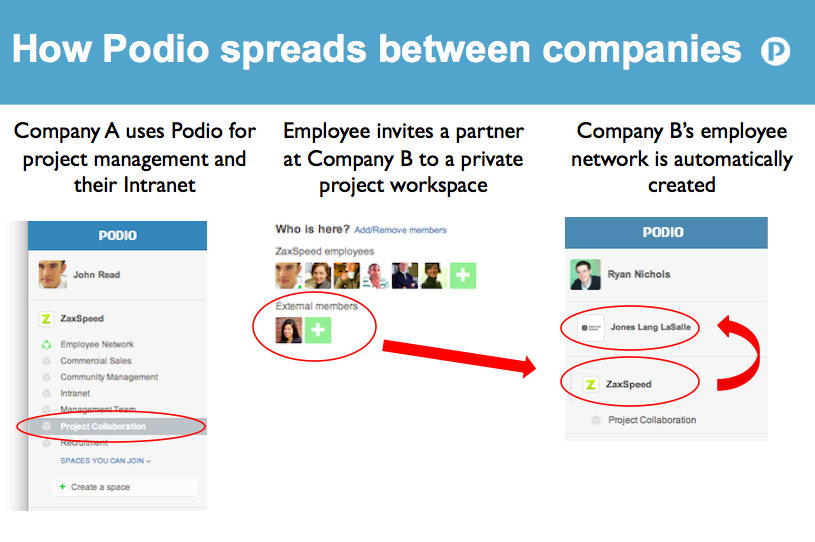
What is the implication of the newer idea?  “Podio can spread virally from company to company across business ecosystems, “ Nichols said, “that’s something that business software has never been able to do: spread virally across companies.” This is the sense in which a new company has seen beyond today's hot idea, cloud computing, and enabled a new kind of cloud-based innovation.


This screen shot shows what that looks like in practice:


As organizations evolve, as the community and social tools of the consumer space find their value expressions within companies and the life of work, we’re sure to find new value delivery opportunities.  Among these will be much more flexible, repurposable work teams, and the rise of internal “free agents” who connect flexibly to multiple organizations, teams, and projects. That's the very model enabled by Podio's user-centric architecture.

There will be more “situational” tech deployments that arise quickly, serve a need, and disappear.  Small businesses will have greater power to look and feel like very large ones, and very large companies may achieve levels of agility, personalization, and responsiveness that could make mom-and-pop operations jealous.


But all that implies a lot of challenges as well.  Companies with legacy appllications and infrastructures, command and control organizational structures, and service delivery structures that are either not there or not fully realized all are positioned to run headlong into the changes that society and technology are advancing.  For small and large businesses alike, a lot depends on how well they understand and act upon the big ideas, the changes at hand, especially the era of you.


In the second part of my discussion with Ryan Nichols, we examine those questions:


What happens when users won't play "Mother May I" with IT?

Monday, August 29, 2011

Tech research without spending big bucks: four information streams for business

Vermeer's "The Geographer" from wikipedia:
the search for new knowledge

This is the third in a series about research for IT and business: designed as a practical guide for those tasked with gathering the information needed to make better decisions, this article presents alternative, lower-cost research resources that should be part of every businessperson’s toolset.


By the time you’re talking about the research buys for a Global 2000 or Fortune 500 company, it’s not too unusual to see annual budgets of $200-500K. Tech research is big business. Say “research” in a business context, what comes to mind?  Usually, some contact with one of the big research vendors, Gartner, Forrester, or IDC.

What are people asking for when they say “research?” Based on the requests I got from business and IT people over the years, it’s usually “vendor comparisons,” “benchmarking/ knowledge of what peers are doing,” “best practices,” and “planning/strategy.”  


Ironically, for all those dollars spent, even the best of the commercial companies can only help you part of the way toward having good answers. In practice, no one company has the depth or impartiality to be your single source of information.  In previous articles, I discussed ways to evaluate and choose from among the big companies as a research portfolio buy.  But many companies will not choose to spend that kind of money.  

Furthermore, just plain good practice for business suggests that the best decision support mechanism you can build should include not just “bought” sources, but also other voices motivated in different ways, and with different resources and different ideas.  

In fact, benchmarking and peer practice, one of the most sought-after answers, is--in my opinion--only available in a paid way at the least granular, least useful level.  I think you’ll be more successful, and get better answers, by following and communicating with peers than via paid research.  The good news is, although the multiple-source approach needs more direct involvement from you it also comes with a dramatically lower price tag.  If you can’t budget for the big research companies, these sources can go a long way; if you do have that budget, the chorus of voices giving you information will be much richer if you add these.


I recommend four information streams in addition to a paid research portfolio:
HP Labs, 1501 Page Mill Road, Palo Alto CA.
High tech from a midcentury flight of fancy
  1. Strategic partners and other vendors: there is a lot of mutual self-interest between the companies that make technology and the people who buy it.  At the simplest level, a vendor you are considering is usually happy to share Gartner or Forrester comparison reports with you, especially if they are favorably reviewed.  If you can’t afford contracts with the research companies, this can be an alternative.  You can get some best practice information and peer benchmarks from vendors as well, but be mindful of the inherent bias.

    Several of the major companies spend hundreds of millions of dollars on their own research and development, but your main point of contact with vendors is likely to be the sales organization.  Sales does not often volunteer an engagement with R&D, but I’ve almost always found them receptive when asked.  Among the best I’ve worked with are:
    HP Labs  When I visited HP Labs in 2003, they showed me an IPAQ PDA equipped with GPS, an internal compass, and the ability to interact with a virtual map.  With the exception of the mobile phone component, it was a spot-on prediction of the location-aware mobile services we use today.  The Mobile and Immersive Experience lab is doing some groundbreaking work on displays, printing, mobile devices, and social interaction.  Every division has a public-facing web site and downloadable research papers, all at no charge.
    IBM research is legendary. While some of the resources here are highly technical, there is a wealth of information for businesses, including the “First of a Kind” program for collaborative innovation on new products and services, and the Experimental Technology Site, which invites users to try new ideas out firsthand.  
    Others who are deeply involved in research include
    Microsoft, Alcatel-Lucent (including another R&D legend, Bell Labs), and SAP.  No discussion of technology research would be complete without mention of PARC, the Palo Alto Research Center run as a separate company by Xerox.   “In the business of breakthroughs” is their own description of the company; PARC invented the laser printer and the graphical user interface (the window/mouse convention at the heart of nearly all computing today.)
  2. Communities:  the tools of social networks we first used as private consumers are in wide use by professionals and businesses.   You can read entire books on this topic alone--and the chances are, you’re already using some combination of these tools.  For the purpose of this report, this section is a beginner’s guide: a social-network way to consume tech and business news, and to establish community with peers and thought leaders.  In the case of nearly every analyst, author, or company you can follow through social channels, you will also find an associated blog or website. Twitter: for a service that conveys information in 140-character tweets, Twitter can be a truly valuable way to get breaking tech news, follow a topic of interest, and have conversations with some of the leading tech minds.  It can also be somewhat daunting; the site is not inherently user-friendly, the short-entry format is awkward, and once you’re following more than a few dozen names, the information stream becomes a torrent and a distraction. There are ways to mitigate all three problems, starting with these fundamental things:
    --you can
    follow someone by name, and see every tweet they post
    --you can
    search by keyword. Put a “hashtag,” or pound sign, in front of search words, to see all tweets so tagged.  For instance, “#ENSW” stands for Enterprise Software; you can then save the search, and generate a list of tweets any time.  See Mashable’s “How to: Get the most out of Twitter hashtags” for a closer look.
    --you can organize the companies and people you follow logically with
    lists, you can follow lists created by others, and you can share your own.  You’re welcome to try out some lists I use, all of which are shared: All Tech Considered (with apologies to NPR for using their title), High Frequency Analysts (valuable, but publish so often they need their own category or their voices would overwhelm everyone else,) and The Business of Business.  
    --Twitter recently acquired
    Tweetdeck, a third-party tool to manage lists and searches by breaking each into its own column in a constantly-updating desktop or browser window. Tweetdeck can also manage and display feeds from Facebook and LinkedIn.

    Facebook, Google+: Although the two competing sites might not like being grouped together, they both feature richer posts than Twitter, with the ability to incorporate photos, video, and links to websites more easily. Both offer comment threads, and the ability to feed posts to specific groups (G+ through “circles”, Facebook through user-created friend lists.)  In my opinion, because of the threaded nature of comments, these are easier to follow than Twitter.  Early in the life of Google +, it took on more of a business “bent” due to heavy tech community adoption, so I’d recommend giving it a try:
    http://plus.google.com. LinkedIn: started as a business networking site, LinkedIn can be a really valuable way to connect directly with peers, and with thought leaders.  Companies can have LinkedIn identities, and share posts and discussions. There are groups as well, searchable by name or topic, or you can create one yourself.  In my experience, LinkedIn groups are not often well moderated, so the value-to-noise ratio can make them a challenge.  Because LinkedIn allows you to do status updates in the same manner as Facebook or G+, it can be a pre-filtered way to communicate with business contacts, a useful step.  Useful advice: if you have favorite analysts within the paid research community, make a point of connecting with them through LinkedIn, Twitter, Facebook, and/or G+ while you are in regular contact.  Analysts sometimes leave the companies where you know them, this protects in advance your ability to stay in touch if that happens. Quora: the value of this question-and-answer site is directly connected with the credentials of the communities of people using it and answering questions; so far, that community seems to be very professional, the dialog is high-level, and there is a great deal of self-moderating.  You can follow individuals or specific questions, and see lists of others who are following them, oftentimes a shortcut to building an expertise community. YouTube: your source of videos about cute cats and flashmobs is also a huge library of free information from major tech companies, research firms, individual analysts, and universities.  As a portal into this side of YouTube, visit the Infrics Channel, where you’ll find playlists by major tech topic, and subscriptions to channels from recommended sources.
  3. Academic sources:  the case for business and technology research with an agenda not driven by either a sponsoring company or the sales cycles of commercial research is self-evident.  Universities are the natural source.  Here are some of the ones I know: Center for Information Systems Research at MIT Technology Review from MIT Sloan Management Review from MIT Harvard Business Review Wharton School of Business at the University of Pennsylvania Center for Information Science Research in the Interest of Society at the UC system
  4. Conferences, and the 80/20 rule applied to research: most everyone speaks of the 80/20 rule at some point: 80% of business comes from 20% of your customers.  If you would like to get a very large chunk of the value of an annual contract with one of the big research firms without spending as much, the best answer lies in foregoing the contract, but paying for some of the big events held by research companies.  Here are the ones I recommend:

    --Gartner’s Symposium may be one of the great bargains in the research field.  Gartner lumps together nearly all the content from every specialized conference they hold each year, does a few minor updates, and packages it with some new presentations, some good keynote speakers, and flashy keynote sessions that would do a Vegas showgirl proud.  Participants have access to ALL the content, including sessions they did not attend, for a year.  Without an annual Gartner contract, you won’t see breaking-news reports or have the ability to talk with an analyst after the conference ends (some analyst one-on-one meetings are included during the event at no extra charge,) but you will have vendor evaluations, a lot of product comparisons, and a huge range of best-practice reports.  At $3795 (2011 pricing,) it’s well under 20% of the cost of many of their annual contracts.

    --Forrester’s
    Forum event is similar, but on a smaller scale: fewer days, lower price ($2095 for the 2011 event.)

    --IDC, not big on multi-day events, does put on one of the highest-value one-day events, their annual
    Directions conference (usually held in March, in Boston and repeated in San Jose, CA.) Directions is notable for an morning spent predicting the coming year for tech and business, and for excellent keynote speakers in the afternoon.  Among the keynotes I’ve seen at Directions are Geoffrey Moore (“Crossing the Chasm,") Nicholas Carr (“The Big Switch”,) and Don Tapscott (“Wikinomics.")   

    --
    EmTech, the emerging technology conference presented by MIT’s Technology Review magazine, is not the place to go to get vendor comparisons or best practice information. But it is the event to renew your faith in the future, and to hear important ideas firsthand from the people creating it.  As an example, when I first attended in 2006, Amazon’s Jeff Bezos introduced a new service: the Elastic Compute Cloud, perhaps the very first use of the term “cloud” I ever heard applied to delivery of IT services through the internet from a third-party vendor.  
Give these a try. Speaking of "best practice" requests, these articles represent my ideas about best practice for IT and business research; one professional service Infrics.com offers is research planning, portfolio and resource evaluation, and in-service training for executives and their reports.  Let me know how I can help.

An Infrics.com business research consult day: money well spent