Showing posts with label agility. Show all posts

Saturday, December 17, 2011

From ReadWriteWeb: CIOs see consumerism as threat


Read this on the ReadWrite Enterprise site and see if it doesn't sound familar:


CIO survey: consumerism threatens the enterprise cloud


One quote in particular is comment-worthy:  "Consumers just have unrealistic expectations for the levels of services that IT departments are capable of delivering, say 74% of CIOs surveyed worldwide and 81% of U.S.-based CIOs. As a result, IT departments are having to be tasked with delivering functionality levels and multiple device support that they're not even ready for."

This is exactly what we've been discussing in the "era of you" series, and is a natural corollary to the conversation I reported with Podio's Ryan Nichols.  The IT organizations as they exist in most enterprises, and by association the businesses they serve, are threatened by the expectations of their users, and by the services those users can deploy themselves without an IT department at all.

The quote from CIOs has a hidden prefix: "As we operate today, if we don't change, we can't meet consumer expectations."  The logical extension of that quote is this: "we have to do things differently in order to meet those expectations."

Three things to start changing today: the big ideas


  1. Get your services house in order.  Structure data, infrastructure, ERP, and other elements that are mission-critical but unrelated to competitive advantage so they can be delivered as reliable, repeatable, recomposable services.  Manage complexity here to enable the flexibility you need at the user level.  This is hard work, but it's crucial to your success. 
  2. Get out of the business of managing devices.  Virtualize users' desktops, adopt stateless devices, sunset old client-server technology wherever possible, require new applications to be web-enabled.  Secure your data and quit thinking that securing the device is your responsibility.  Once you are stateless, every app and all the data lives in the cloud, and the device has virtually no security risk anyway.
  3. Organize for less command-and-control, more responsibility moved to individuals and teams. No organization can compete well in an era of empowered users when everything is subject to committee, cover-your-ass stagegates and approvals, and "I can't budge until I'm 100% certain I won't be blamed for doing the wrong thing" thinking.  
The fears about consumer demands are very real.  Moreover, in an improving economy, those consumers inside your company and without will vote with their feet, and take their skills and their business to those who implement the action points above.  

How much longer do you think you can get away with inaction? 


Tuesday, November 22, 2011

The two-minute, user-created app: how Podio leads the era of you

--the first of two parts: an “era of you” Big Idea feature story


The ability of end users to choose and implement technology without technical skills, often without the need for a formal IT department, is central to one of the largest tech trends shaping the future.  The ways we live and work--and the degree of personalization and individual choice we command as we do--are undergoing a revolution.  


Podio's Ryan Nichols
The best IT department is the one you no longer need.  We’re seeing this emerge first in small companies, then the small-and-medium-business (SMB) category.  Neither will large enterprises be immune, as newly-empowered employees and departments begin taking tech matters into their own hands when IT can’t perform fast enough.


Innovative startups see this trend--the “era of you”--and are moving quickly to be a part of it.  This story is about one of them, and a silicon valley veteran who is on the forefront.
 

Ryan Nichols can speak about emerging technology from a career across many enterprise tech worlds.  Classic in silicon valley credentials, he is a Stanford business graduate, and directed the corporate strategy group at SAP.  He was VP for marketing and product management at cloud integrator Appirio.com when we first met in early 2009 during an Appirio engagement at Avon.  He blogs at ComputerWorld.


Today, Nichols looks at the way work is done and says, “there has to be a better way.” In September, Nichols joined Podio, a company that’s working to enable end users to be their own app creators, and offer the platform to deliver that “better way.”  


The Copenhagen-based company exudes startup excitement and agility.  Their U.S. office is in a downtown San Francisco tech co-officing loft space, an old brick two-story building with steel casement windows; somehow it escaped the wrecking ball as conventional office buildings loomed around it. There’s the ultimate tech-driven gestalt of jeans, rumpled dress shirts, open beams and brickwork, backed by the hum of people on a mission to make their fortunes while re-making the world.
 

On a blustery early November day in San Francisco, my meeting at Podio US involved a 20-something receptionist-for-the-whole-building waving me in, saying “Podio’s upstairs at the back left corner, the tables by the window,” picking my way through tables occupied by 10 or 12 other companies, and a short wait while Nichols returned from a meeting.  There are no cubes, no offices per se, just a series of small conference rooms around the perimeter of the workspaces, with no sort of reservation system beyond “hey, is anyone using this room?”   If you’ve ever trudged to work in a standard corporate IT cube farm, this is really heady stuff.


I’m in a modern, Aeron-style chair at a trestle table with three or four other Podio staff, a programmer intent on his laptop nearby.  Like a lot of knowledge workers lately, for everyone in the building, their entire office is their laptop, tablet, smartphone, a backpack or messenger bag to carry them, and a WiFi connection. There are a few bigger monitors scattered here and there, a whiteboard or two, a dusting of sticky notes from a brainstorming session.


The “this is the very edge of innovation” feel is in stark contrast to my last meeting with Nichols, at Appirio’s San Mateo office in August, in a modern atrium office complex across a suburban boulevard from a shopping mall, all khakis and BMWs.   As I would learn just a few days later, that August meeting was right before Nichols announced the move to Podio.  There are two different startup vibes in the bay area now.  As we’ll learn in the course of the conversation,  even a very innovative company like Salesforce turns out to be one step behind the curve from a use-case and architecture perspective.  Nichols told me, “I saw Appirio grow from 30 people to 300 people, and I was kind of itching to get back to 30, which is about where Podio is now.”


“When I saw what Podio was doing, building a very, very horizontal platform to help businesspeople develop their own apps that they really owned and fit the way that they wanted to get work done, that was pretty intriguing to me,” Nichols explained, “It seemed like a really fresh approach. In a world where there are a lot of online project management tools, a lot of online task management tools--the idea of creating a platform for people to create their own tools was pretty intriguing to me.”


Nichols says, “I sometimes describe Podio as “Excel meets Facebook.”  


"Today, when you’re in that in-between space--you know it’s too structured to get done in e-mail,  but there’s no application to support you--what you do a lot of the time is create an Excel spreadsheet with ten, twenty things on it, five columns, column number four is “who’s responsible,” and column number five is “comments.”  And you e-mail it out to 10 people and you say “fill this out for me.”  That ought to be an app.  That’s a perfect use case for Podio.  That’s something that’s “no developer required.”  It’s as easy to build as an Excel spreadsheet, but when you’re done, it’s as engaging and interactive as Facebook.”


Here is a video from Podio demonstrating how users build their own apps:


Nichols says, “This is definitely one of those services where it’s “go to podio.com, enter your e-mail address, and you’re off and running.”  You’ll have an app two minutes later, and you can make it your own two minutes after that, and then share it with your team two minutes after that.”


The platform is mobile-enabled automatically, with iOS and Android apps that allow users to log in and use their Podio applications with no custom programming. 


Nichols tells the story of a small firm that took Podio’s platform and ran with it:  “we had a swimming pool cleaning company in Kuwait that created an application to help them to manage groups of guys going out in vans to clean pools.  There’s no commercial application to support the pool cleaning business, at least not one that’s any good. 


So they created an app in Podio where there’s a pool app that keeps track of things like pH balance and depth and so forth, and a van app that keeps track of who’s in what van.  Then, every time there’s an algae bloom in a particular pool, they have a little collaboration around “hey, let’s get the expert involved and figure out how to handle this.”  


They built it and were using it on the web, which was fine, guys were bringing back their clipboards and recording everything back in Podio.  When we released our iPhone app, it changed the game.  

They deployed iPhones to all their drivers, and they automatically had their own mobile app, which is a pretty cool thing.  For an organization that size, I think they have one IT contractor, no IT department essentially, to be creating their own mobile productivity app that they really run their business on is pretty cool.”  


Podio has signed up 40,000 organizations.  A Podio app store already lists 600 applications, arranged by horizontal uses like business development, marketing, or CRM and by vertical business needs like accounting, HR, and property management.  More than 200,000 have been downloaded by Podio users.


But Nichols added, “app store is almost the wrong word.  We call it an “app store” because people think app store is the place to get apps, which is exactly what it is.  But today It’s not really a commercial environment; all the apps in the app store are free and a lot of them, an increasing number of them, are created by Podio users.  We seeded it with apps that we created.  Now, Podio users are sharing the apps that they’ve created, largely to do exactly that."


Podio is “a classic freemium model.”  The first 10 users at a company are free, so is collaboration with anyone outside your company; Podio just announced that the platform will also be free to university students worldwide.   Beyond that, “there’s a per-user, per-month charge for every employee you have using the Podio platform.”


Podio reflects the “era of you” idea all the way to its data architecture, which, as Nichols explained, “has the user at the center of its data architecture, so “user” comes above “org,” which is the exact opposite of every other SaaS system out there--org is kind of the primary thing, and you almost had to do that, because at the time, the only way you could sell the concept of multi-tenancy to a buyer was to really emphasize the “tenant” part of that.  Really emphasize the fact that everything was in a virtual container for your company.  The buyers have matured enough to realize that there are other ways of providing security, and we can put the user at the center, and have users be part of multiple orgs.  That’s an enormously powerful shift.”  


Podio handles user and role security segregation, so users only have access to the things they have rights to. Nichols says, “It’s every bit as secure as the other model, but it gives us a whole bunch of flexibility.  It’s just more usable to be in one environment and see all the different organizations that you work with, because we all work with different organizations.”


In this way, Podio has demonstrated one of the ways in which innovation happens; the idea of user-centricity needed deployed iterations of multi-tenant cloud computing to help the buyer community adapt to the concept and prepare them for a newer model.  In the user-centered data and security model, it becomes much simpler for Podio to allow users to be part of networks with other Podio users.

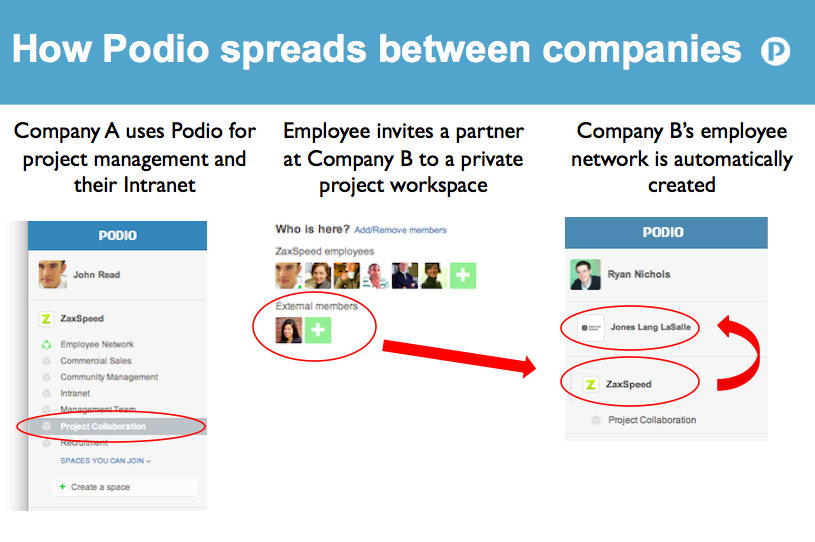
What is the implication of the newer idea?  “Podio can spread virally from company to company across business ecosystems, “ Nichols said, “that’s something that business software has never been able to do: spread virally across companies.” This is the sense in which a new company has seen beyond today's hot idea, cloud computing, and enabled a new kind of cloud-based innovation.


This screen shot shows what that looks like in practice:


As organizations evolve, as the community and social tools of the consumer space find their value expressions within companies and the life of work, we’re sure to find new value delivery opportunities.  Among these will be much more flexible, repurposable work teams, and the rise of internal “free agents” who connect flexibly to multiple organizations, teams, and projects. That's the very model enabled by Podio's user-centric architecture.

There will be more “situational” tech deployments that arise quickly, serve a need, and disappear.  Small businesses will have greater power to look and feel like very large ones, and very large companies may achieve levels of agility, personalization, and responsiveness that could make mom-and-pop operations jealous.


But all that implies a lot of challenges as well.  Companies with legacy appllications and infrastructures, command and control organizational structures, and service delivery structures that are either not there or not fully realized all are positioned to run headlong into the changes that society and technology are advancing.  For small and large businesses alike, a lot depends on how well they understand and act upon the big ideas, the changes at hand, especially the era of you.


In the second part of my discussion with Ryan Nichols, we examine those questions:


What happens when users won't play "Mother May I" with IT?

Monday, November 14, 2011

Wired Magazine interview with Jeff Bezos: Kindle Fire, taking the long view, and why Amazon is the opposite of Apple

Image from wired.com
Steven Levy, a senior writer at Wired magazine, just shared a preview of an upcoming feature on Amazon.com's Jeff Bezos.

Jeff Bezos Owns the Web in More Ways Than you Think

I admire a lot about Amazon, and this article is well worth reading; do you agree with Google's Eric Schmidt, who says the four most important tech companies are Google, Apple, Facebook, and Amazon?

Much of what Amazon.com does falls right in line with the big ideas I've been evangelizing here on infrics.com: back-end standardization to enable agile deployment of services, and server-based, device independent delivery of applications and content are leadership areas for Amazon.  Levy presents the idea, which I think is spot-on, that if Apple is post-PC, Amazon is post-web, "in which our devices are simply a means for us to directly connect with the goodies in someone’s data center."  

I follow Steven Levy on Google +

Thursday, November 10, 2011

Mission: Cats has a $300 (total!) tech budget, but you'd never know it by their social media impact

Benton and Maeby at Mission:Cats
They are up for adoption.
On 18th Street in San Francisco, in the Mission just around the corner from Folsom, is a new 2 story office condo, urban-hip and all corrugated steel panels. It houses a lot of very small businesses, some of them using 300 square feet or less. On the ground floor is a micro coffee shop, barely large enough for a couple of customers.  There's a hair salon.  And Mission Cats, a cat boarding hotel run by life partners Genna Darby, 23, and Ash Wilkie.

The women are not from the tech world, but they're lifetime tech natives.  Mission: Cats is not a big business (5 employees total,) nor a tech startup hoping to be acquired and make its founders' fortune. But they have much to teach us all about technology in business, largely because for Genna and Ash, it's just something they know instinctively.  As Genna told me, "it's a cat care business, but I feel like the technology is just so integrated, just like it's integrated into the City of San Francisco and the bay area. People just expect it."


Genna Darby
What do they do?
  • Cat-cams are online for a good part of the day, allowing owners to check in on their cats in real-time.
  • Throughout the day, staff take photos and videos of the cats, and post them on Facebook and tumblr.  
  • Real-time alerts of new posts are issued throughout the day on Twitter.
  • Cats Exclusive monitors reviews on Yelp, and takes full advantage of referrals from the site. 
  • Owners can also opt for photos and videos by e-mail while they're away from their cats 
How much has all this cost the small startup business? "We have about $300 total invested in software and equipment," Genna said, "we have a used Mac mini we bought on Craigslist, some webcams, and we did spend $30 for webcam management software from Evocam."  Mission: Cats uses the free gMail product, a free-while-in-beta webcam broadcasting service from Sensr.net, Intuit's Quickbooks payroll ("online, not the downloaded version"), and payment systems from Square, which allows small businesses to swipe and accept credit cards using a smartphone.

*
Square, was founded for companies just like Mission: Cats, who want to accept credit card payments using simple tools with minimal setup and simple processes.  An iPhone, iPad, or Android device, a small card reader that plugs into the earphone jack, and a flat 2.75% fee are all that’s required.
Technology Review examines the history and potential of Square in the feature story, “The New Money.”

Every Yelp review has been positive (one is 4 stars, every other review was 5, the top rating,) and customers make comments like, "the thing that impressed me the most was how devoted the owners are to their guests - my cats got a lot of attention. Did my cats tell me this, you might ask? Is this a crazy cat lady review? Nope, I could see it on the cats cams and could also tell from the way my cats behaved when I picked them up. It was so great for me to be able to see them with updates and pictures on twitter and fb."

From another review:  "each time (my cat has) stayed there they've introduced her to some of the Wonder Cat Rescue kittens that are fostered there and Risa's had a ball playing with them. I know this because I've seen photos on Facebook, gotten the daily email updates from Mission: Cats staff ($1/day), and even seen a video they posted on their blog. I actually have one of their webcams open in another browser window right now and I can see a staff member playing with my cat. Amazing!"
Prudence relaxes.
Cat images from missioncats.tumblr.com

The effect: although started just seven months ago, Mission: Cats is operating at near full-capacity in their 1300-square foot facility.  They are sold out for the Thanksgiving and Christmas holiday seasons; while I was there, Genna took several calls, politely turning away overflow customers with "here are several other cat boarding facilities we trust, or try Craigslist for sitters, but be sure to find one that's insured and bonded."


Mission: Cats serves as a powerful reminder of one of technology's most important emerging roles: to re-personalize the business experience.  It is a relationship builder and community enabler.

Technology ushers in the era of you.

Some important things Mission: Cats "gets," and some important lessons for much larger firms:
  1. People buy more than just goods and services, they buy relationships. Technology--especially social technology--is a critical success factor for any business making good on this promise.
  2. It is worth the time to maintain those social connections with customers. Social technology is not an inconvenience, not an added cost. It is a core of what business is about.  By the way, did you notice the customer comment about the daily e-mail?  Mission: Cats has turned social technology into an upsell opportunity, a $1/day charge for an e-mail and photo of your pet every day. 
  3. Good use of technology is more about what you do than what products you choose.  Lightweight, inexpensive solutions, many from the consumer world, can have big business value. 
  4. Technology reduces barriers to excellence, and to competition. Mission: Cats is low "tech inertia," and was able to start delivering big-company value from day one, at minimal cost.
If your business doesn't now have this mindset, a realization that technology-enabled community is easy, real, and important, I promise you have competitors who do.  Some of them might not be in business yet, and see your company's inaction as a huge profit opportunity waiting for them to explore, with tools they can acquire at low cost and implement in days.  Are you ready to learn from a gen-Y 23-year old with $300 to spend on IT? 


Tuesday, October 18, 2011

C-suite talk: can you make complexity disappear?


Building blocks, not jigsaw pieces.
Image from countingblocks.com

In the last of the C-suite articles, I talked about managing complexity, either by relentlessly simplifying processes and applications, or by abstracting a complex service in such a way that it appears simple to those who consume it.  This time, let’s take a closer look at the latter: how to use complexity abstraction and why it’s an underappreciated business tool.

A service oriented enterprise is composed of 4 service tiers (for more on service tiers, see “How Technology Disappears”):

  1. Lines of business, end users
  2. Service Orchestration
  3. Service Management
  4. Infrastructure
There are exceptions, but in general, the tiers build on one another: service management uses the products of the infrastructure service to enable service orchestration to serve end users. One of the simplest measurements of success at each level is the degree to which service providers can offer consumers freedom from concern over where the service came from and how it was provisioned. It just works.

This is not revolutionary, but it’s very actionable. By simplifying and standardizing component parts of complex things, the care taken by providers at each service tier abstracts the complex into a simple, consumable product.  How can you do this?

  • Standardize: practice strong, almost rigid exception management when customization is requested at lower service tiers.  This is an area, especially in IT, where businesses have traditionally operated backwards.  Your business and your employees are locked down to enable success of highly customized infrastructure and applications, when it should be exactly the other way: very high levels of standardization at lower levels in support of ease of deployment and customization at the user side.  If you are abstracting complex services by standardizing their component parts, you almost automatically guarantee your business is right-side-up here.
  • Reliability engineering: Attack the weakest link in a complex process, and do the heavy lifting required to get its reliability up. Think of your car engine: the ignition system and fuel delivery systems were once high-maintenance items that demanded a fairly high level of driver involvement. Today, both are handled by computers. The Bosch computer in my old car has now managed ignition and fuel injection without attention for 22 years. Reliability is a great complexity abstraction if you make it a component of service delivery.
  • Building blocks, not jigsaw puzzle pieces: each can be assembled into something useful, but jigsaws can only be assembled one way.  Building blocks are the ultimate abstraction, and can create many outcomes from standard shapes. That structure is the metaphor for your abstracted complexity.  If it only has one purpose, it it worth it?
  • Externalize: instead of creating abstraction inside your own four walls, pay someone else to do it for you, and purchase a consumable service, which appears simple to you as the consumer. This is the province of services like cloud computing, third party payroll managers, and distribution services like UPS.  Their success lies in managing away the complex so you don’t have to.  It’s their core business strength.  Is it really worth it to make it part of yours?  The greater core simplicity you can structure into your business--the areas that don’t justify customization or added complexity--the more opportunities this solution presents.  The explosive growth in enterprise-ready external services and their abilities is also moving favorably in your direction.


The idea is to create a virtuous circle: structuring for managed services enables simplification and abstraction of complexity, which enables greater agility and higher business efficiencies. It sets you up for “one question to rule them all,” namely, “do I have to care about where that service came from, or can I just put it to work?”

Tuesday, September 20, 2011

C-Suite talk: agility starts with 2 questions


C-Suite Talk: an Infrics.com series about ideas that matter to executives

Individuals--consumers of technology--move through rapid change like dancers. New ideas, new products, short implementation times and perpetual beta? Not only do they make it look easy, as former Texas governor Ann Richards joked about Ginger Rogers, they do it “backwards and in high heels.”

Corporations--enterprises--move like hikers with a 90-pound packpack. Burdened by legacy technology, the sheer size of their businesses, and business practices laden with feature creep, the best answer they can give to technology is often “not now,” and sometimes, it’s just plain “no.”

Without seeking to make light of the very real challenges of running a business, don’t you sometimes sit alone in your office contemplating your own business, and wish you were more of a dancer and less of a plodder?  If there is one single element that stands between you and agility as far as business is concerned, it’s complexity.  

Complexity sneaks in like a thief, but because it’s stealthy, it works its way through your processes and technologies until it begins to seem more like the norm than an unwelcome intruder.  Reducing complexity is strategic, but it takes a solid tactical mindset to achieve. As you tackle complexity in your organization, try looking at it by asking these 2 questions:  
Is there a simpler way to do this?


If not, how can we manage the complexity so that it appears simple to those who use it?


Images from wikipedia.org


These are hardly revolutionary ideas. But the thought of seeing complexity through two different lenses is a powerful one that can be used in a lot of situations.  One can build on the other.  Can you simplify underlying processes as a means of abstracting a more complex one?  Can an abstracted complex process enable a simpler approach in another area? 


When you either reduce or abstract the complex, you service-enable it; the components of your technology and your business become building blocks. It is not realistic to think you can eliminate the complex, but it is a critical business success factor that you manage it.  

Complexity management is the business equivalent of laying aside the backpack, and walking on level ground instead of uphill all the time.  It is a core concept of the service oriented enterprise, and is a core tool for the C-Suite to manage enterprises well.