Showing posts with label Forrester. Show all posts

Saturday, February 9, 2013

Forrester: 15 emerging technologies to watch

There are many ways to group related ideas in the near-term tech future; this is a pretty good version from Brian Hopkins at Forrester Research, and a report from the enterprise architecture community on their emerging tech predictions.

He completely misses the upcoming revolution in artificial intelligence (AI)-driven digital personal assistants.  One aspect of the AI tsunami I'm just starting to be aware of is its potential to make sense of big data in a human-like manner (understanding context, relationships, data cleansing,) but at computer speeds.  We'll see these ideas show up in new releases of Apple's Siri, and in Google Now.

Also not even mentioned: 3D printing.  I'm not certain if we will see it impacting business in a big way by 2018, but the implications of "print to order" parts and products could well be important.  I'll write more soon about another 3D printing effect I haven't seen mentioned anywhere:  what happens when you can store things digitally, share them freely online, and create-to-order?  Will it bring about an intellectual property revolution like the one we saw with digital music, books, and video? What will happen when we can treat physical objects as part of the stateless future, in which content, storage, and delivery are decoupled from each other?

Let me know in the comments if you think there are other big topics in the 5-year horizon.

Forrester's Top 15 Emerging Technologies To Watch: Now To 2018 | Forrester Blogs:

'via Blog this'

Wednesday, August 15, 2012

New tech research models: threat to Gartner and Forrester, opportunity for you?

Business models, the realities of making money by selling goods or services, change.

  • You don't see many Tower Records stores any more, do you?  The retail music business model changed with digital distribution, and stores selling CDs were cut out of the picture. 
  • How long has it been since you made a phone call from a pay phone?  Mobile technology ruined that business model.
  • Remember the original AOL?  Pay us for your ability to get online, and we'll offer internet access along with our packaged services?  I do, but just barely; the original AOL for Windows did not even have a browser.  But you weren't supposed to need one, AOL provided everything.  

Could the big research company business model
be headed for a similar fate?
Research about technology has a business model too.  There are many variations, but one of the most common models is to pay for an annual contract with a large research company--typically Gartner, Forrester, or IDC--with the expectation that their size will get you most of the knowledge you need to make better choices.  To make sure you're really covered, many companies buy a portfolio of more than one of those contracts.   But in general, it's the original AOL idea applied to research.  

I've written about the business of research, and as you may remember, buying those portfolios was part of my career for many years.  In my opinion, some of the same trends I cover--mobility, social networks, the "freemium" model--are triggers that imply a threat to the "big research" business model.  Even if not, remember your old standby, the SWOT analysis (Strengths, Weaknesses, Opportunities, Threats?)  If changes in access to business tech research represent a threat to the big companies, they may also give your own enterprise an opportunity to get a broader range of information, at much lower cost, and with far better decision-making impact.  

In the past few months, I've been talking to former leaders from big research about this idea, and about the future of the business.  In articles to come, we'll hear what it's like to set off on your own as an expert, and how that business model can succeed.  We'll talk about social means of gaining business and tech expertise, how to move from a one-to-many model (such as Gartner/Forrester) to a many-to-many model, as exemplified by specialized individual consultants.  

And I'll report about an emerging trend: the growth of tech information requests coming directly from the business, not the IT department.  The last point is significant; it's another way in which the consumerization of business threatens to disintermediate the IT department, thereby threatening the business model of IT itself.  It's pure Era of You effect in action.

The first of the three-part series on new research models:
My, how you've changed: Technology research meets Social, Consumerization, Freemium

This article is part of Infrics.com ongoing coverage of the business of research:


How are you handling research within your own organization?  Do you feel that big research contracts are a good investment?  Are you turning more to blogs and direct contact with subject matter experts?  I'd like to include your experiences in this series.  Let me hear from you. 

AOL sign in screen image: http://blog.boxedart.com/nostalgia/10-websites-and-services-we-loved-in-the-90s/

Tuesday, July 31, 2012

Fast Company on the freemium business model: Infrics on the ways it may endanger the big research companies

How To Thrive In The Free-Product Economy | Fast Company:

Here is the major quote from this excellent Fast Company article:

If a product on the market can be monetized by any means other than directly selling it, a comparable version of that product will eventually be offered for free.

The "freemium" business model--free services as a gateway to monetization--is showing up in many places.  WiFi, which was a pay-to-use service in its earliest iteration, is classic.  You still pay in some situations, like on board an airplane, and in some hotels and most airports.  But Starbucks and thousands of other businesses deliver the internet for free as an incentive to spend money in other ways.   

I'm in the process of learning more about the future of technology research.  In the interviews with former leaders and insiders of the classic paid research model (Gartner, Forrester, IDC, etc.) one trend is emerging.  Those paid models are about to face a threat from social means of business research, and from the idea of giving away research findings in the hope of earning money from paid consulting work.  Infrics.com is based on that model; everything on the site is free, there are no subscription or access fees.  As the writer and owner of the site, I hope you'll like what you read well enough to hire me to assist your company or team with emerging technology strategy.  Look for the article on new research business models soon. It will include resources to lower your own research costs while getting better advice and insights.

How much longer will the big research company model hold up?  Is it in danger of being "freemiumed" to death, or will the big companies be disintermediated into irrelevancy?  What do you think?

Sunday, April 22, 2012

An Insider's Guide to Technology Analysts--from ReadWriteWeb

It's very rare I see anyone else commenting on the actual business of research, so this article is a great find, with some very useful advice.  A former analyst is candid about the business drivers behind analyst firms, and offers recommendations to help you get the most from the analysts you speak with.  Excellent read, well worth your time.

An Insider's Guide to Technology Analysts:

'via Blog this'

Monday, November 28, 2011

An Infrics.com research consult day: money well spent

Since I took the infrics.com site live last spring, the most popular articles by far have been the ones on planning, buying, and managing research.

Vermeer's "The Geographer"
image from wikipedia.org

I understand this well, because in all my years of buying research for a living, I never did see good objective analysis of the field itself: the strengths and weaknesses of the research companies, the sales and customer service strategies they use, and the best practices for spending research money as a consumer of those services.    The series of articles is here:  The Business of Research.

Those articles are free, and always will be.

At the paid level, an Infrics.com consult day combines that insight with specific advice for your own company, delivers a research strategy and action plan, and acts as catalyst to make best use of the time and money you devote to your research efforts.

These are the deliverables:


  • Opening workshop;  your own business research needs, mapped in real time against your organization, culture, and goals. Who are your research "customers?" What do they want?  What do you want FOR them?
  • The big 3 research companies: Gartner, Forrester, and IDC.  Best practices for choosing, buying, and working with each.
  • Other research sources: some are free, many are much less expensive than the big three. Learn what they are, why they're important, and how to work with them.
  • Social tools and expertise sharing in your organization: how they are a "hand in glove" fit with research. Work hands-on with social tools.
  • The 80/20 rule for research: could it be the best answer for your organization?
  • Strategic and tactical research: why you need both, how to get highest value from each.
  • Organizing internally for research value: centralized? federated? distributed?  Ways to envision research management.
  • What's your RoR--Return on Research? How to know, when standard metrics measure the wrong things.
  • Walk away with a specific action plan. Entry level, mid-tier, or all-in? We'll create each, and compare cost and returns.
  • Ongoing support: unlimited followup calls for 12 months after the initial engagement at no additional charge.
The one-day on-site engagement is $2500 plus travel.  While I will happily discount for non-profits, NGOs, and startups, I will NOT gouge a larger corporation for huge consult fees just because it's the standard (a day with an analyst from the big three is typically priced at $10k.)  Please feel free to ask about customized plans,  and combinations with other workshops like Tech Triggers Innovation, or Big Ideas.  

E-mail to discuss scheduling or other questions, or leave a comment below and I'll contact you.

Tuesday, September 13, 2011

The Enterprise Social Landscape Enters Teen Years | Forrester Blogs

Blog post from Forrester's Rob Koplowitz, available w/o a Forrester account.

Rob summarizes their first Wave (product comparison tool, similar in function to Gartner's Magic Quadrant), and does a good concise update on progress in social tools for enterprises.

The Enterprise Social Landscape Enters Teen Years | Forrester Blogs:

'via Blog this'

Monday, August 29, 2011

Tech research without spending big bucks: four information streams for business

Vermeer's "The Geographer" from wikipedia:
the search for new knowledge

This is the third in a series about research for IT and business: designed as a practical guide for those tasked with gathering the information needed to make better decisions, this article presents alternative, lower-cost research resources that should be part of every businessperson’s toolset.


By the time you’re talking about the research buys for a Global 2000 or Fortune 500 company, it’s not too unusual to see annual budgets of $200-500K. Tech research is big business. Say “research” in a business context, what comes to mind?  Usually, some contact with one of the big research vendors, Gartner, Forrester, or IDC.

What are people asking for when they say “research?” Based on the requests I got from business and IT people over the years, it’s usually “vendor comparisons,” “benchmarking/ knowledge of what peers are doing,” “best practices,” and “planning/strategy.”  


Ironically, for all those dollars spent, even the best of the commercial companies can only help you part of the way toward having good answers. In practice, no one company has the depth or impartiality to be your single source of information.  In previous articles, I discussed ways to evaluate and choose from among the big companies as a research portfolio buy.  But many companies will not choose to spend that kind of money.  

Furthermore, just plain good practice for business suggests that the best decision support mechanism you can build should include not just “bought” sources, but also other voices motivated in different ways, and with different resources and different ideas.  

In fact, benchmarking and peer practice, one of the most sought-after answers, is--in my opinion--only available in a paid way at the least granular, least useful level.  I think you’ll be more successful, and get better answers, by following and communicating with peers than via paid research.  The good news is, although the multiple-source approach needs more direct involvement from you it also comes with a dramatically lower price tag.  If you can’t budget for the big research companies, these sources can go a long way; if you do have that budget, the chorus of voices giving you information will be much richer if you add these.


I recommend four information streams in addition to a paid research portfolio:
HP Labs, 1501 Page Mill Road, Palo Alto CA.
High tech from a midcentury flight of fancy
  1. Strategic partners and other vendors: there is a lot of mutual self-interest between the companies that make technology and the people who buy it.  At the simplest level, a vendor you are considering is usually happy to share Gartner or Forrester comparison reports with you, especially if they are favorably reviewed.  If you can’t afford contracts with the research companies, this can be an alternative.  You can get some best practice information and peer benchmarks from vendors as well, but be mindful of the inherent bias.

    Several of the major companies spend hundreds of millions of dollars on their own research and development, but your main point of contact with vendors is likely to be the sales organization.  Sales does not often volunteer an engagement with R&D, but I’ve almost always found them receptive when asked.  Among the best I’ve worked with are:
    HP Labs  When I visited HP Labs in 2003, they showed me an IPAQ PDA equipped with GPS, an internal compass, and the ability to interact with a virtual map.  With the exception of the mobile phone component, it was a spot-on prediction of the location-aware mobile services we use today.  The Mobile and Immersive Experience lab is doing some groundbreaking work on displays, printing, mobile devices, and social interaction.  Every division has a public-facing web site and downloadable research papers, all at no charge.
    IBM research is legendary. While some of the resources here are highly technical, there is a wealth of information for businesses, including the “First of a Kind” program for collaborative innovation on new products and services, and the Experimental Technology Site, which invites users to try new ideas out firsthand.  
    Others who are deeply involved in research include
    Microsoft, Alcatel-Lucent (including another R&D legend, Bell Labs), and SAP.  No discussion of technology research would be complete without mention of PARC, the Palo Alto Research Center run as a separate company by Xerox.   “In the business of breakthroughs” is their own description of the company; PARC invented the laser printer and the graphical user interface (the window/mouse convention at the heart of nearly all computing today.)
  2. Communities:  the tools of social networks we first used as private consumers are in wide use by professionals and businesses.   You can read entire books on this topic alone--and the chances are, you’re already using some combination of these tools.  For the purpose of this report, this section is a beginner’s guide: a social-network way to consume tech and business news, and to establish community with peers and thought leaders.  In the case of nearly every analyst, author, or company you can follow through social channels, you will also find an associated blog or website. Twitter: for a service that conveys information in 140-character tweets, Twitter can be a truly valuable way to get breaking tech news, follow a topic of interest, and have conversations with some of the leading tech minds.  It can also be somewhat daunting; the site is not inherently user-friendly, the short-entry format is awkward, and once you’re following more than a few dozen names, the information stream becomes a torrent and a distraction. There are ways to mitigate all three problems, starting with these fundamental things:
    --you can
    follow someone by name, and see every tweet they post
    --you can
    search by keyword. Put a “hashtag,” or pound sign, in front of search words, to see all tweets so tagged.  For instance, “#ENSW” stands for Enterprise Software; you can then save the search, and generate a list of tweets any time.  See Mashable’s “How to: Get the most out of Twitter hashtags” for a closer look.
    --you can organize the companies and people you follow logically with
    lists, you can follow lists created by others, and you can share your own.  You’re welcome to try out some lists I use, all of which are shared: All Tech Considered (with apologies to NPR for using their title), High Frequency Analysts (valuable, but publish so often they need their own category or their voices would overwhelm everyone else,) and The Business of Business.  
    --Twitter recently acquired
    Tweetdeck, a third-party tool to manage lists and searches by breaking each into its own column in a constantly-updating desktop or browser window. Tweetdeck can also manage and display feeds from Facebook and LinkedIn.

    Facebook, Google+: Although the two competing sites might not like being grouped together, they both feature richer posts than Twitter, with the ability to incorporate photos, video, and links to websites more easily. Both offer comment threads, and the ability to feed posts to specific groups (G+ through “circles”, Facebook through user-created friend lists.)  In my opinion, because of the threaded nature of comments, these are easier to follow than Twitter.  Early in the life of Google +, it took on more of a business “bent” due to heavy tech community adoption, so I’d recommend giving it a try:
    http://plus.google.com. LinkedIn: started as a business networking site, LinkedIn can be a really valuable way to connect directly with peers, and with thought leaders.  Companies can have LinkedIn identities, and share posts and discussions. There are groups as well, searchable by name or topic, or you can create one yourself.  In my experience, LinkedIn groups are not often well moderated, so the value-to-noise ratio can make them a challenge.  Because LinkedIn allows you to do status updates in the same manner as Facebook or G+, it can be a pre-filtered way to communicate with business contacts, a useful step.  Useful advice: if you have favorite analysts within the paid research community, make a point of connecting with them through LinkedIn, Twitter, Facebook, and/or G+ while you are in regular contact.  Analysts sometimes leave the companies where you know them, this protects in advance your ability to stay in touch if that happens. Quora: the value of this question-and-answer site is directly connected with the credentials of the communities of people using it and answering questions; so far, that community seems to be very professional, the dialog is high-level, and there is a great deal of self-moderating.  You can follow individuals or specific questions, and see lists of others who are following them, oftentimes a shortcut to building an expertise community. YouTube: your source of videos about cute cats and flashmobs is also a huge library of free information from major tech companies, research firms, individual analysts, and universities.  As a portal into this side of YouTube, visit the Infrics Channel, where you’ll find playlists by major tech topic, and subscriptions to channels from recommended sources.
  3. Academic sources:  the case for business and technology research with an agenda not driven by either a sponsoring company or the sales cycles of commercial research is self-evident.  Universities are the natural source.  Here are some of the ones I know: Center for Information Systems Research at MIT Technology Review from MIT Sloan Management Review from MIT Harvard Business Review Wharton School of Business at the University of Pennsylvania Center for Information Science Research in the Interest of Society at the UC system
  4. Conferences, and the 80/20 rule applied to research: most everyone speaks of the 80/20 rule at some point: 80% of business comes from 20% of your customers.  If you would like to get a very large chunk of the value of an annual contract with one of the big research firms without spending as much, the best answer lies in foregoing the contract, but paying for some of the big events held by research companies.  Here are the ones I recommend:

    --Gartner’s Symposium may be one of the great bargains in the research field.  Gartner lumps together nearly all the content from every specialized conference they hold each year, does a few minor updates, and packages it with some new presentations, some good keynote speakers, and flashy keynote sessions that would do a Vegas showgirl proud.  Participants have access to ALL the content, including sessions they did not attend, for a year.  Without an annual Gartner contract, you won’t see breaking-news reports or have the ability to talk with an analyst after the conference ends (some analyst one-on-one meetings are included during the event at no extra charge,) but you will have vendor evaluations, a lot of product comparisons, and a huge range of best-practice reports.  At $3795 (2011 pricing,) it’s well under 20% of the cost of many of their annual contracts.

    --Forrester’s
    Forum event is similar, but on a smaller scale: fewer days, lower price ($2095 for the 2011 event.)

    --IDC, not big on multi-day events, does put on one of the highest-value one-day events, their annual
    Directions conference (usually held in March, in Boston and repeated in San Jose, CA.) Directions is notable for an morning spent predicting the coming year for tech and business, and for excellent keynote speakers in the afternoon.  Among the keynotes I’ve seen at Directions are Geoffrey Moore (“Crossing the Chasm,") Nicholas Carr (“The Big Switch”,) and Don Tapscott (“Wikinomics.")   

    --
    EmTech, the emerging technology conference presented by MIT’s Technology Review magazine, is not the place to go to get vendor comparisons or best practice information. But it is the event to renew your faith in the future, and to hear important ideas firsthand from the people creating it.  As an example, when I first attended in 2006, Amazon’s Jeff Bezos introduced a new service: the Elastic Compute Cloud, perhaps the very first use of the term “cloud” I ever heard applied to delivery of IT services through the internet from a third-party vendor.  
Give these a try. Speaking of "best practice" requests, these articles represent my ideas about best practice for IT and business research; one professional service Infrics.com offers is research planning, portfolio and resource evaluation, and in-service training for executives and their reports.  Let me know how I can help.

An Infrics.com business research consult day: money well spent


Monday, June 6, 2011

Evaluating research companies: Gartner, Forrester, and IDC


This is a series on research about technology and business. It is offered as a toolkit for those undertaking tech research, or considering the purchase of research services; the focus is almost entirely on qualitative research, not statistical research.

In the first article, I introduced the concept of mapping your business against the research services. This article is a report from the field on the services, strengths, and shortcomings of the major research firms I’ve dealt with.  In articles to come, we’ll think of research in its broader context as an ongoing learning exercise, and I’ll expand on the idea of research portfolios that include sources beyond the major firms.

What big research firms have in common

For the companies mentioned here, there is a core business model:

  • Annual contracts for "seats" granting web access to (mostly) written reports, based on the original work of analysts in the employ of the firm.  In general, that intellectual property represents the value that customers pay for.
  • The one thing I most wanted to buy from research companies was an enterprise license, in which anyone within my company could access the products of the research companies. None of them will sell you that license.  IDC and Forrester allow dynamic reassignment of the licensed seats during the contract year, which partly offsets that limitation. Forrester also allows reassignment of its extra-cost Leadership Board seats, which I found to be especially valuable.
  • Your ongoing contact with the company will be through a client team: almost always composed of someone from sales who is the feet-on-the-ground in-person contact, plus an internal resource with more direct access to the analysts.  
  • You will be strongly discouraged from contacting analysts directly, even once you know them from previous experience with their work, although every firm has a process for requesting telephone meetings with analysts.  Depending on the license model you purchase, you may have a fixed or an unlimited number of those calls at your disposal.  The controlled access is part of the intellectual property the firms sell you.
  • Once you engage the company often enough on a specific topic or request, or pass a certain level of engagement with one team or analyst, the companies may decide that goes beyond the bounds of your contract terms and has become a “special service,” for which you will pay separately.
  • Companies sell some services “pre-customized” to serve interests by role (very common right now), or by vertical industry. It’s also common to hear research firms sounding like someone on a first date.  If the interest you express while in the sales process is at all within the range of what that firm offers, they really, really want you to like them. You’re far more likely to hear “of course we’re experts in that field,” than “no, much as I’d like to tell you otherwise, our competitor X is better there.”
  • For that reason, I advocate buying a portfolio of research products if you can, and part of the value I offer is help from outside to make that process smarter and more informed.  This is becoming a smaller field to choose from as acquisitions by the bigger companies have ended the separate existence of some well-known brands.  


The companies also typically expose some of their knowledge capital through conferences, some huge and “everything including the kitchen sink,” like the Gartner Symposium, some specialized, like Forrester’s Enterprise Architecture Forum.  It’s not unusual to find walls around some part of the content sold by the big firms, for which you have to add another service to your contract; these are usually around some form of data--especially benchmarking data--gathered in the process of their research work.  

What the research companies are NOT:

  • Although the big consulting firms like Accenture, BearingPoint, or Deloitte also maintain large numbers of their own research analysts, they have a limited overlap with firms like IDC and Forrester.  Consultants are more likely to give specific, one-off advice, and then offer you the opportunity to pay them to help you take action on their recommendations.  
  • The work of research companies is not like that of academic institutions.  There is internal peer review, but the value proposition of big research firms also includes a consistent point of view across different specializations.  They are driven by what they can sell, and they are commercial institutions.  That is not a bad thing, but I recommend that you always view the value of commercial research reports through the same critical lens you would use for the products you buy from any vendor.
  • In the same vein, star analysts--those who really excel in thought leadership and new ideas--may self-select out of the corporate research model.  There are great minds working for Gartner and its competitors, but there are many others outside that business model.  Some of the best analysts I know of are former employees of the big firms, now operating privately or as part of boutique research firms.


Here is the map of research companies value, plotted against horizontal/vertical, and strategic/tactical
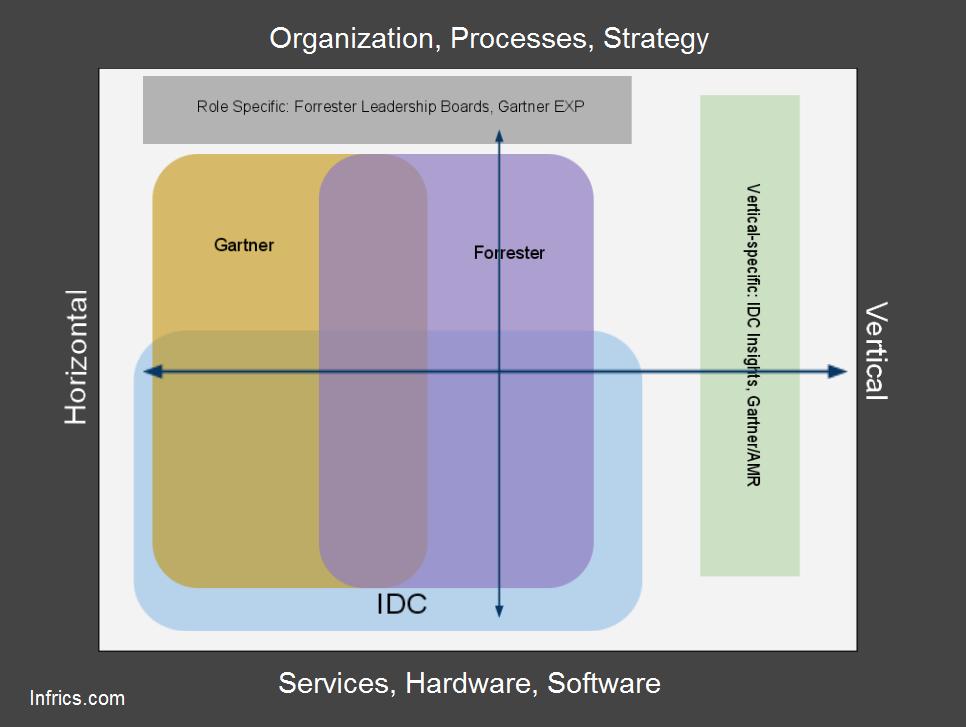


Thinking about the big 3: Gartner, Forrester, and IDC

These comments are both a report of my own experiences over 10 years as a client, and my opinions about the strengths and weaknesses of the companies. But remember, if one of them fits a specific need or pattern based on your own business/research mapping, that can heavily influence what I report.  

Although I’ve mostly had all three of the companies in my research portfolio, there is only one that has ALWAYS been there without fail:

IDC

What they offer:  IDC is the research arm of the IDG group of companies, publisher of tech magazines like Mac World, Network World, and CIO. They have over 1000 analysts distributed all over the world.  IDC is 47 years old; its focus is strongly data-oriented around business metrics like market share, volume of sales, and growth predictions.  IDC’s traditional client base is the companies that make and sell technology-related products and services, although that has grown somewhat over the years to include more for the people who buy and implement those products.  Vertical Insights offers specific services in Manufacturing, Retail, Financial, Healthcare, Energy, and Government.  A benchmarking service is sold separately for pricing of equipment like laptops, desktops, and servers.

What I like:  IDC is without peer for maintaining personal customer service despite being a large company.  I had relationships with both sales and internal client service that spanned years; alone among the big three, IDC could get me answers within hours to help with an urgent request from the CIO.  IDC often pulled specific data from unpublished research for me upon request, allowing me to send my internal clients a chart or Excel sheet that answered their questions in ways not available through a website search.

IDC’s sales and intellectual property model is the most flexible of the three companies. The company philosophy seems to be “the more people who see our work, the better our sales prospects will be,” so they allowed me share any reports freely, and to post IDC reports to our corporate intranet (which neither Gartner nor Forrester will allow, or even negotiate as a contract element).  IDC’s contracts are generous with seats, relatively unrestricted in terms of who can request analyst calls, and are based on a concept called service units.  Every year brought a bank of these units which could be “spent” for analyst time, reports that were not part of the master agreement, or for any other custom work.  Gartner will not do that, and Forrester will, but only by special request.

In terms of content, IDC has far and away the best global reach. If I needed a report on an HR software firm in Poland, or comparisons of ERP vendor market shares in China, IDC was my go-to answer every time.  Although Gartner sells data about tech spend and market share under its Dataquest brand, I never once felt the need to purchase it because of the wealth of data included in my IDC contract as part of the base price.

The IDC Directions conference, held every year in silicon valley and Boston, has consistently been one of the highest-value one-day tech events I’ve ever attended.

Problems/limitations:  IDC is not the place to turn for a report on best practices, for an RFP template, or a study on IT organization.  IDC can tell you a lot about the tech companies' market shares, but does little in the way of vendor comparisons.  Those are not part of their core strength, although I believe from talks with IDC that an effort is being considered to extend that part of their offering, which may put them in more direct competition with Gartner and Forrester.  IDC is an excellent--for me, indispensable--companion to either Forrester or Gartner, but there are few cases where it would work as the sole research buy.

The IDC website and search interface for users has been the worst of the three companies for years.  The design and graphics of their reports tend to be unimaginative, but they are very rich in useful graphs and charts.  IDC has never done conferences longer than one day very well, and have mostly abandoned the concept.

Forrester

What they offer:  Forrester is the smallest of the three firms discussed here, but they compete in the big research firm space, oftentimes being best-of-breed for their specialized expertise.  Forrester has not chosen to compete in a big way in the market for data about tech sales and market share, but rather to be a thought leader in a couple of major areas: the philosophy of IT and business (reflected in a company-wide push going on for several years now to relabel “IT” as “BT,” Business Technology.)  Forrester’s other major focus is marketing, e-commerce, and social networking--a choice which places the company very well for the current needs of the research market.

Forrester’s delivery and sales model is based around IT roles like CIO, Enterprise Architecture, Sourcing, and Knowledge Management.  They sell both role-specific regular access seats as well as “Leadership Board” seats with facilitated peer interactions, a dedicated client services representative, and “elite traveler” perks such as dedicated lounges at conferences.  

What I like: Forrester’s focus on marketing and social networking is currently the best among their big-research peer group.  The Consumer Technographics surveys and reports are the most complete insight into online behavior, and are especially well structured to allow drill-downs by demographic and behavior style.  They sell some of the marketing expertise separately to non-IT parts of businesses, but there is considerable overlap.  Forrester was the most useful research partner I had when talking to business strategists. If you are very highly focused on web, social, and e-commerce, you could manage with Forrester alone.  

Forrester’s Wave product, their graphical vendor comparison tool, is similar in approach to the well-known Gartner Magic Quadrant.  However, the wave lets end users change relative weights of the comparison criteria by downloading and interacting with an Excel spreadsheet, resulting in a graphical display customized for the specific need--a very cool enhancement.  Forrester is not as prolific with Wave reports as Gartner is with MQs, but where they exist for the products you’re investigating, points go to Forrester.

In general, Forrester’s analyst team seems very engaged with customers, and there are some truly excellent individuals: Claire Schooley in e-learning and HR. Randy Heffner in SOA, web infrastructure, and Enterprise Architecture. Paul Hamerman in applications, ERP, business process. Forrester’s 3-day Forum event, held every spring in the western US (usually Las Vegas,) is a very worthwhile conference, with great breadth of topics, but not the intensity of crowds and packed agendas you find at the Gartner Symposium.

Problems/limitations:  Forrester is not likely your best choice if you’re about to do an end-to-end overhaul of your data center, or other highly infrastructure-oriented tasks. Their work tends to be more North America focused, especially when compared with the global presence of IDC; within the last 2 years I have seen more international reports from their technographics series (to get full access to all technographics reports, you must purchase a separate option as part of your contract, but many of them are included in the basic access plans.) Among the role-specific options I’ve considered or purchased, both the CIO and the Sourcing Leadership boards were strong offerings, although in general, my internal clients found the Gartner offering on Enterprise Architecture stronger than Forrester’s.  More on this in the Gartner commentary.

Forrester can get overly wrapped up in its own hype about an internal catchphrase like Business Technology, and I have sensed a “blinder effect” there, in which it appears as if there had been a corporate decision to include that concept in as many reports and engagements as possible.  This syndrome pops up a lot in the world of research-as-a-business, as companies jockey for market position based on their advocacy of their own ideas or buzzwords.  

Forrester seems to experience churn in its sales force more often than either Gartner or IDC, and it shows in customer service--midpack between IDC at the top and Gartner on the other side.  This is an often-overlooked part of the research relationship; the sales rep is your primary interface with the value you are paying for.  Good ones, and good companies, invest a lot of time in that relationship, and so do you.  Lose that rep, and much of that time he or she spent understanding your needs is gone.  The burden then falls on you to educate the replacement.  This is compounded by the fact that none of the three companies has a very good internal CRM system to maintain that customer knowledge, or to enable a company-wide end-to-end view of the work you undertake together.  I will say that Forrester has gotten much better here in recent years, but I’d recommend that one of the questions you ask of any company is, “what is the average tenure of your sales team with specific clients?”  

Gartner

What they offer:  Gartner is a large, multipurpose research firm, very highly commercialized, and of the three, it is the one that comes closest to providing value to almost every aspect of the enterprise.  They also use a system of role segmentation for value delivery, selling a variety of access seats at different price points and with different combinations of access and specialization.  

There are separate offerings around data--IT benchmarking and reports on market share, spend, and size--plus a contract review and negotiation service, role-based coaching and peer network facilitation, and a very active conference division.  The Gartner Symposium, held in several cities around the world each year, draws about 10,000 attendees to the biggest venue, every October at Disney World in Orlando.  In typical Gartner fashion, they bill it as “the world’s most important gathering of CIOs and senior IT executives.”

What I like: The breadth of coverage Gartner offers is a big plus for them; further, within a corporate IT organization, most people have been exposed to Gartner’s work before. There is a certain comfort in going to a meeting and saying, “Gartner says this about that,” although in my opinion, the Gartner view is not always the best one, nor the most complete.  And the company does some excellent work, including some good heavy lifting around product evaluations and some of their reports on best practices. For many best practice areas, Gartner offers "toolkits," .zip file compilations of worksheets and checklists--an excellent, actionable addition to their research.

Gartner is smart about acquiring talent and specialization it does not already have in house; their acquisition of Meta Group at the end of 2004 dramatically filled out Gartner’s Enterprise Architecture offering, making them a leader in the field.  Gartner had virtually no presence in the manufacturing vertical, leaving the field wide open to AMR and the IDC Manufacturing Insights practice, so they acquired AMR at the very end of 2009.  According to Gartner’s own report, they have made 32 acquisitions since they went public in 1973.

Over the years, Gartner has alerted me to some genuinely important ideas that continue to influence my thinking to this day; they were the first of the big research firms to realize the importance of consumer technologies to the enterprise IT landscape. A 2006 Symposium presentation on “middle out architecture” by Nick Gall, who came to Gartner via the Meta acquisition, is one of the best works of thought leadership I’ve ever seen.  Ditto with Hung LeHong’s “Goog-Azon: the Web 2.0 Monster That Will Devour Your Business Model,” a spot-on prediction about the evolution of mobile-device shopping augmentation through location, context, and search.   Because of the sheer volume of output from Gartner, it takes diligence to sort out the truly useful from the boilerplate and the routine, both of which are also present in abundance in their work. Just be mindful.

Although I have serious reservations about the way Gartner does business (see below,) I still believe they are a very worthwhile part of a research portfolio. Where I recommended Forrester for social and e-business, if you had to go with just one company and were more toward the tactical/horizontal end of the research map, Gartner would be your logical choice.

Problems/limitations:  In my opinion, the very real value of much of Gartner’s work is masked by the bad feelings engendered by their customer-facing operations.  If there is one word I heard more often than any other about Gartner, it is “arrogant.”

There is no pleasure to be had in dealing with Gartner as a business; their sales approach is an order of magnitude more aggressive than either Forrester’s or IDC’s. The array of service offerings at contract time is overall less flexible than their competitors, and more restrictive than Forrester or IDC about intellectual property rights.  I would frequently approach senior executives from the IT organizations I worked in about their experiences dealing with Gartner sales before I became the central point of contact.  The most common reply: “Can you PLEASE keep them from bothering me?!”   

Of the three companies discussed here, you really feel Gartner’s size, and not in a good way.  The process of scheduling a call with an analyst is cumbersome; you must go through a scheduling office, which has no insight into the information you’ve shared with your customer service team, and frequently misfires matching analysts with your request. You can never expect nuance in a place where you most need someone who can say “I know just the person you should talk with.”  Contrast this with IDC, where my internal rep scheduled appointments directly, actually talked with specific analysts about my questions before setting up appointments, and had little trouble putting me in touch with someone by phone within 24 hours if I had an urgent need.

Gartner’s web site has search restricted to only paid members, so you can’t even see titles of articles you are interested in without buying the service.  Both IDC and Forrester have full public search enabled, with executive summaries of content, and the ability to purchase individual articles.  I believe that ability is central to showing a company’s value to clients and prospects.  

Gartner has different sales organizations in different parts of the world, and this became a serious problem for me in my last engagement with them.  When I wanted a single global sales point of contact for all my Gartner dealings, they told me it was not possible.

Overall, in my opinion, Gartner would be a pretty great company if it only got out of its own way and worked harder on relationships and less on sales.

Summing up:  If you are in business, the chances are good you will either be approached by one of these companies, or will consider them on your own as a resource.  These insights may help you in the process.   This topic is one where your comments are especially welcome.  What has your own experience been like?  Do you work for one of the firms, and would like to add to the content, or challenge any opinions?

For the last 10 years, I bought research products (primarily from Gartner, Forrester, AMR, and IDC) for a couple of major manufacturing firms: at the pre-purchase stage, I evaluated the research offerings and recommended a portfolio of research buys, then worked with their sales teams and our internal finance and legal departments on licensing and pricing. Post-purchase, I was the central point of contact between the firms and our internal clients, spending many hours each week on the companies’ websites, working with their customer service teams, and sitting in on many hundreds of calls with analysts. During that period I managed a total of nearly $2 million in research buys.  I am available for phone, web conference, or in-person consultations about research planning.  Although I clearly have a point of view, I have no commercial stake in the outcome of any plans or purchases you may make, just a lot of experience in the field.

Update, August 2012: Since this was published in the summer of 2011, I have been talking with people in the research business, and observing the emergence of some new research models that may threaten the value proposition of Garter, Forrester, and IDC.  There are several articles on this idea:

New tech research models: threat to Gartner, Forrester. opportunity for you?

My, how you've changed: Technology research meets Social, Consumerization, Freemium

Next in the research series: Tech research without spending big bucks: four information streams for business

An Infrics.com business research consult day: money well spent