Showing posts with label SaaS. Show all posts

Thursday, December 1, 2011

What happens when users won't play "Mother, May I" with IT?

--part 2 of the "Big Ideas" conversation with Podio's Ryan Nichols


Last week, Infrics.com featured Ryan Nichols, formerly of SAPs strategy office, formerly of cloud integrator Appirio, and now a vice president for applications at startup Podio.com.  Nichols has been on the front lines of the three current faces of enterprise software: big legacy ERP, cloud platforms and applications, and now with Podio, end-user empowerment, and the rise of "citizen programmers" who can purpose-build their own applications without the presence of any IT department.  Here is the article about Podio's approach:  "The two-minute, user-created app; how Podio leads the era of you."

Life in the C-suite is never easy, but right this minute CIOs and the CEOs of their companies face daunting tech challenges: on the one hand, there are enormous pressures to be more agile, yet still deal with legacy technology installations, execute on existing efforts, and manage costs; on the other, a loud and increasingly empowered base of business units and end-users who are mad as hell at IT for not keeping pace with their tech experiences as consumers--and who now have the power to source their own tech solutions without any input from the corporate IT department. Add to this the simple fact that a larger corporation has built-in inertia and change resistance that render it like a big steamship approaching icebergs; you can see the danger, but avoiding it is slow at best.

"Shadow IT," or "Rogue IT" is big enough to elicit this article from CIO.com last summer, "How to Keep Rogue Cloud Software from Making IT Irrelevant", and a cover story on the issue in September.  Research studies suggest that corporate IT departments significantly underestimate the extent to which users in their own businesses are "doing it for themselves."

Since Nichols has had a presence across many facets of enterprise IT, and now is with a company designed specifically to put tech development into the hands of end users, we talked about the whole "era of you" idea, which led to this discussion:

Don:  This whole social, consumerization, all this is moving toward a dramatically greater degree of personalization for each of us as an individual and as a worker, but also moving the power to choose, implement, and get value from technology much closer to the people who use it every day. Taking IT out of the picture as the people without whom you can’t do your job. One reason Podio is especially fascinating to me is that it seems to facilitate that “era of you” concept--that you do it for yourself.

Nichols:  that’s exactly what we’re going after. The first wave of platform-as-a-service has been very enabling for IT, where IT can build apps without having to worry about infrastructure...but I have to say, at my last company we ran our entire business on salesforce and force.com, and I never once built an app of my own. I took what IT gave me and then when I needed to get something done, I turned to a Google spreadsheet. That’s broken, there’s this huge in-between space where all the time I’d be trying to manage something, trying to get something done and getting it done in e-mail and documents--there’s a more productive way to do it.

Don:  You play “mother may I” with IT.

Nichols:   Yeah, and that’s broken too. It’s in nobody’s interest for me to do that. But these are the tools that I’m given, so that’s what I make do with. There should be a better way.

Don:  If I’m a CIO, and let’s say I’m at a company that’s three or five billion dollars a year, and I’m seeing this promise, but I’ve got huge volumes of data and thousands and thousands of employees, and regulatory compliance, and my legal department...what’s your advice to a CIO like that? Podio might be part of their picture, but they understand on some level that this is all broken, too. It’s a common refrain among a lot of analysts that enterprise IT is broken.

You represent kind of the extreme of ultra-agile user empowerment. As someone who’s out there scouting in that area, what’s your message to big legacy-bound CIOs?

RN: First of all, I have to communicate, they’re in a tough spot. There’s no easy answer for enterprise CIOs because it’s not a question of whether they’re going to empower their employees or not. Their employees ARE empowered. They are doing what they need to do to get their jobs done and to the extent that IT helps them with that, great, but when that stops, they’re ALREADY doing the rest themselves. And whether they’re doing that by using existing tools in unintended ways--e-mailing spreadsheets of very confidential information around--or whether they’re using unauthorized tools like the plethora of consumer-grade apps that we see being adopted like crazy in the enterprise.

So it’s happening anyway. It’s ITs choice to get behind what’s already happening and put in some degree of combination of control and support.  If you are participating in that and engaging in that dialogue in as secure a way as possible, then that’s a far better outcome for your enterprise than either pretending like it’s not happening, putting on the blinders, or putting up a fence and saying “you’re not going to break out of this fence,” because that’s just not the reality.  This is happening anyway and I think ITs only choice is to embrace and extend: accepting the fact that, yep, people are going to be using their own devices. Let’s embrace that and figure out how to make that secure.  They are going to be adopting all the software tools that are available to them on the internet to get their job done.  Let’s figure out how to do that in a way where they’re using SSL to access them, just to give an example.

I think those are going to be the tradeoffs that enterprise IT is going to have to make.

Don: That sounds like it might be part of your own value proposition to Podio, because you’ve been on the other side. With a career at SAP, that’s about as un-Podio as you can get and still talk about technology.

RN: (laughs) I think that’s true. You know, the reality is that enterprise IT is going to be looking to different vendors for different things, and I think one of my learnings from the time I spent at SAP is that SAP’s enterprise customers want SAP to be the system that doesn’t change, be the system that they don’t need to touch more than once every five years. That’s what they want SAP to stay, which is why it’s so tough for SAP to innovate and change because at the end of the day, their customers don’t really want them to.

Don:  As you know, except for the cost of licensing and maintenance, probably the biggest single complaint with that company is UI (user interface.)  It has been since I’ve ever known of SAP. Podio must care very very deeply about UI because it’s just you and me out there making things.

RN: It’s one of the core values in the company, and one of the reasons I think we really benefit from our headquarters in Copenhagen. There’s just something in the DNA of Podio around beautiful, simple, clean design. It’s the only choice. If something’s complex, if it’s cluttered, if it’s wrong, it doesn’t make it into the product. It helps being able to start with a clean sheet of paper; even systems that have started five years ago, ten years ago, are burdened with a usability legacy that Podio isn’t burdened with.

When you’re able to start fresh and build something that’s built to support this type of work, you can make it beautiful and that’s absolutely what we aim to do.

Don: It’s funny to think of salesforce.com as being the slower alternative.

RN: Salesforce has a really nice problem of being dragged upmarket and embraced by IT and embraced by IT at larger and larger companies. And that’s great for salesforce, it’s good for their business. I think that it does leave space for a lighter weight way of doing things. This is a natural trajectory of solutions to be dragged up, and that creates a space underneath for a new generation of software with even subtle architecture shifts that you have to bake in from the beginning."

In another part of our conversation, Nichols and I talked about the challenge a company like Podio might present to a CIO, ways to think of that as an advantage instead, and how enterprise software may soon be created and shared via social means--how tech-enabled community may enter the enterprise equation in new ways:

Don: Since I used to wear a corporate IT buyer’s hat, I can say to Podio, “you’re the gateway drug for shadow IT, and you’re going to cause me a huge headache when all these user-developed apps start hitting my enterprise.” How do you respond to that idea?

RN: I would argue that you’d much rather have those things in Podio, where we have centralized administration and you can control the users who have access to these different spaces than where they are today, which is on Excel spreadsheets that get forwarded to who knows whom and posted who knows where, and saved in dropbox.

Don, So if I take off my corporate hat and become the Podio salesman, I say “no, we’re the gateway drug that lets you say yes to your users.” Is that the value proposition?

RN. That’s exactly right. And over time, there’s a lot more that Podio can do to empower IT to be even more supportive and involved in this process. We’re early in that.

Don: If I’m an SMB or a startup, and I’ve got a green field, this sounds extraordinarily attractive, but what if I've got legacy apps in my enterprise and I still want to take advantage of the agility and user empowerment that Podio promises?

RN: I sometimes draw a pyramid; companies that are bigger use Podio in different ways than companies that are smaller. Companies that are smaller use Podio for a broader variety of things because they don’t have established systems. Small companies use us as a CRM system, which, even a 500-person company would struggle to use Podio as the customer master system of record, it’s not really built for that. But for a smaller team it works great.

For larger teams, we have 500 person teams using Podio all the time for project management, event management, those sort of use cases, where it’s not the system of record, it’s a situational app for this project, for this event.

You can bring data into Podio in a couple of different ways, which is helpful if you have an existing system, and want to use Podio as the social layer, the integration layer. We built out integrations with a lot of systems that our small business customers use, like Freshbooks and Zendesk for ticket management. We have a number of customers who use Zendesk for their ticket management, but when they want to have a discussion around a particular ticket--how is this going to translate into our product roadmap--they take that into Podio, and Podio is kind of the social layer around the Zendesk ticket. The (Podio) apps are built up around that data that comes in from Zendesk.

We have a handful of those integrations today, that’s an area that we’re growing in, and that actually comes back to your earlier question about the developer community. I spend most of my time talking about these business-person developers. That’s the second half of our developer community -- the ecosystem of SaaS applications that we’d love to integrate with Podio, so that Podio can be that extensibility layer. The easiest way to build an app to extend Zendesk should be Podio, right, the easiest way to extend Freshbooks should be Podio.

We have a couple of those early proofs of concepts, but that’s the other area that I’m looking to grow our app community. That’s a more commercial aspect of our app ecosystem. Today our app store is primarily businesspeople building apps to share them to support each other and to swap best practices, and to just be more effective. That’s what’s going to motivate a businessperson to share an app in our app store. An ISV is going to build a Podio integration and then use that as a way of driving traffic to their business, making their solution more attractive to their customers.

Don: so there’s a place for VARs (Value Added Resellers) there too?

One consultancy in particular has put Podio into more than 50 of their clients. This is despite having no formal resale program and no formal VAR program. They just find it to be a very effective of doing the stuff at the edge where the business has all these requirements that they don’t want to go off and get an app for this, an app for that. They just want them all to be in one environment where you’re just getting your work done--and that’s Podio.

Don: It strikes me that if so many people have the power to create their own app, some people, maybe across different companies, are going to end up solving similar problems at the same time. Is there a social means for them to share knowledge or find subject matter expertise? Where does that fit in Podio’s universe?

RN: So this is where our app store is headed. App store is almost the wrong word. We call it an “app store” because people think app store is the place to get apps, which is exactly what it is. But today It’s not really a commercial environment; all the apps in the app store are free and a lot of them, an increasing number of them, are created by Podio users. We seeded it with apps that we created. Now, Podio users are sharing the apps that they’ve created, largely to do exactly that.

They’re putting it out there they know that this was a useful starting point for them, but they’re curious how other people are doing it. Every app has its own feed, a common feed, where people are engaging in dialogue. And that’s really the first step towards building out communities that help us go to market vertically. We found that we had over 50 real estate brokers using Podio to manage their interactions with their real estate clients. None of them are competitive with each other, they’re all in different geographies, and I’d love to put those 50 real estate brokers together into a Podio space. Let’s put those 50 people into that space and get them swapping tips and tricks with each other. That’s the direction you’ll see us go, we haven’t done much to connect those 50 people with each other yet, except for the app store, so you’ll see us move more in that direction."

Enterprise IT as we have known it is in trouble.  But the intersection of the three big ideas I've been elaborating this year offers hope, even to very large companies and very large enterprise IT operations.  As Infrics.com big ideas coverage continues, we'll build out that outline for a better future:
  • Core services where you maintain security and regulatory control, and rigorously standardize to provide reliable, predictable tools for business units and users to create the tech answers they alone understand best.
  • How stateless devices let enterprises get out of the business of managing laptops, tablets, and phones, and why it's one of the most powerful ways to make things better.
  • Organizational structures--flatter, modular, and collaborative--that free empowered users to drive the business forward.
  • Social and application tools at the user level, and the social behaviors that can revolutionize business process and execution.
  • ...and the IT department that disappears into the business itself, at last delivering the promise of technology as trusted business partner.

More on this soon, in the forthcoming article, "How business succeeds in the era of you"


Monday, August 1, 2011

How Technology Disappears: Part 2 of "A World of Services"

Thinking of technology delivery as an expression of services is a big idea.  Services help technology in business disappear.   
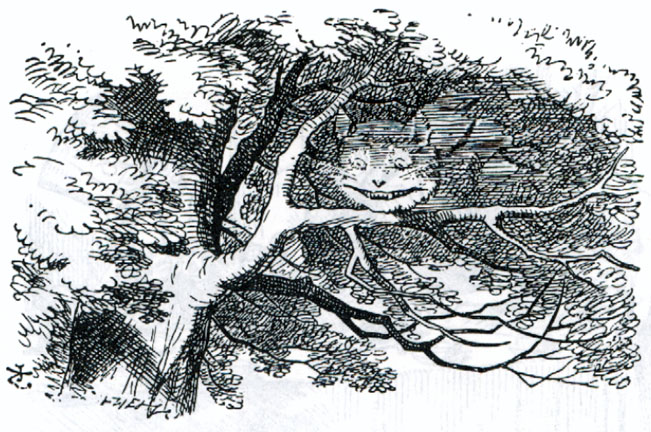
Cheshire Cat image from victorianweb.org

Why is this important?  What’s the payoff?

  1. Agility: The holy grail of business technology is to get to value more quickly.  Services move IT toward plug-and-play, and away from custom-tailored, take-forever-to-deploy solutions.
  2. Cost: standardize, externalize, gain economies of scale. Spend time and money on the things that make you competitive.
  3. Services are a foundational part of the move to stateless devices.  “Your-business-as-a-service” is a perfect match for “any device/any time/anywhere.”
  4. Services are foundational as part of moving decision-making about technology away from those who provide it (the traditional IT department) and toward those who use it.
As we focus on what that means as a trend, let’s examine the idea of services and think of them as part of the future of business.  

Service definition 1: simplify and standardize complex processes

Building a house is a good example of simplified services. Doors and windows are simplified and built to standard sizes.  You can buy what you need off the shelf and install it without customization, secure in the knowledge that it will fit and meet regulatory codes.  Because it was manufactured in large quantities in a standardized way, economies of scale make it much less expensive than a custom-made equivalent.  In exchange, you accept the range of sizes, styles, and colors, and design the house to accept the standards.

In business, most IT functions labeled “-as-a-service” are built on a model like this; users accept some standardization and buy the service as offered.  But that doesn’t fit for every business need, especially when the legacy technology grew up around ever-increasing levels of customization and complexity.  Which leads to:

Service definition 2: abstract complexity

Frankly, some parts of business are complex, and there is no magical way around it.  Even if you overcome the change management issues around greater simplicity of business processes, there are still regulatory and legal complexities that cannot be avoided. There are some complexities that deliver competitive value. But there are ways to abstract that complexity and mask it so that it appears simple. Someone has to manage complexity, but they can deliver it in such a way that those who use the service neither know nor care what is going on behind the scenes.

For an example of this, look to your car.  In the last 25 years, something remarkable has happened to automobiles.  Engines and transmissions, even in inexpensive cars, have growth dramatically more complex than before: turbochargers (sometimes 2 of them), multiple valves per cylinder, with continuously variable valve timing. Direct injection of fuel, electronic automatic transmissions with up to 8 speeds--all controlled by a computer system more powerful than mainframes of the recent past.  

It’s all abstracted from the driver. Start the car and it goes, without you having to care about a single one of those technological marvels.  Furthermore, during the 100,000 mile warranty period, the only maintenance required is fluid and filter changes.  Most of the engine is shrouded in molded plastic, looking more like a plug-in module than a piece of machinery.  Motive power as a service.  

The technology disappears, the benefit is what’s consumed.  

That’s the model current businesses and their IT departments can aspire to as a means of managing the complexity that can’t be eliminated.  The central questions

  1. Does this have to be complex? Is this a complexity of heritage process or legacy technology that is not needed?  Is it a worthwhile tradeoff to lose some customization to gain agility and lower cost? If so, you can move to the “simplify service” route.  Classic examples, standard office applications like word processing and e-mail.  
  2. Is this complexity that adds value, or is unavoidable for structural reasons, such as regulatory compliance?  If so,  the goal would be to abstract that complexity away from processes or people who use it, so that to them it appears simple.  For each complex service, ask question 1 again: are there components of this complexity I can simplify to make the abstraction process faster, easier, cheaper.

If you have succeeded, the result will be “building blocks” for technology and business processes, standard-appearing components.  They can be consumed--used as-is--or recombined to create other services.  

A hallmark of service orientation: those who provide a service know and care about the way it is provided, those who consume it don’t have to: DKDC (don’t know, don’t care.)  As service orientation spreads through IT and a company, DKDC spreads downward from the top, while power to deploy technology and combine services spreads upward toward users.

Service delivery starts with the end user, and works back until it reaches infrastructure. At the top, the main deliverable is “IT as a service.” That service is itself composed of individual and federated services.  This chart shows what that would look like:


The lower levels are foundational for those above. The Service Management level and Service Federation levels represent what I believe to be the future of IT within companies:

  • Definition and management of services becomes a central role, highly technical and specialized positions in the organization tend to be externally sourced as individual service components or packaged as third party services. Internal skills include high levels of focus on service contracts and service level agreements.  The orchestration of services and the management of quality of service delivery take on new importance.
  • Business applications are delivered as a service, either directly by a cloud vendor, as composite applications created in-house through federation of other services, or as legacy applications delivered through desktop virtualization.  
  • At the Delivery level, the close tie-in with stateless computing shows its value.  The entire “business as a service” experience is delivered through a web interface, and IT gets out of the user device management business.  
  • Key vertical roles within the services organization are the technology architect, who works across the various disciplines on service design, integration, and delivery; and the business technology analyst, a main point of contact between top-level service consumers--the users and the business departments--and the various service delivery teams.  But note, DKDC even extends to this level of consumer; if infrastructure-level services are deployed correctly, the analyst does not need to know or care how they are delivered.  

When technology disappears, information technology will have grown up; delivery of business capabilities through services is how that happens.

Next in the Big Ideas series, we’ll look at how stateless computing and a world of services become success triggers for the third major idea: flattening of organizations, and the movement of tech power ever closer to those who use it.

Friday, July 22, 2011

Tell me where it hurts: part 1 of "A World of Services"


Think about where it hurts when you consider the current state of technology in business:


"I'll need a business case, an ROI analysis, approval from legal
and finance, a project manager, FTEs, and
a development environment in three minutes, or we're all dead!"
  • Business technology seems moribund; it takes forever and costs too much to do things you can do easily in the consumer technology world.
  • CIOs would like to see themselves as Mr. Spock to the CEO’s Captain Kirk: a trusted consultant who comes up with the right solution, standing by the captain bravely staring into the future.  In practice, IT is often more like Mr. Scott in engineering, asked to perform the impossible with astoundingly complex machines, scrambling to save the day. When Kirk said, “Mr. Scott, I need warp speed in three minutes or we’re all dead!” Commander Scott always came through.  Unfortunately, CIOs don’t have scriptwriters on their side.
  • Needless to say, if the fictional USS Enterprise operated like the enterprises we serve every day, it would have fallen out of the sky very early in the first season. There has to be a better way.

People have dreamed of a streamlined, responsive IT and a truly agile business for a very long time.  Enter the idea of services.

Web services. Service Oriented Architecture. Cloud services. Software as a Service. Middleware-aaS. Platform-aaS. Infrastructure-aaS.

Decompose technology delivery into manageable services. 
 
“Service” is a veritable workhorse of an IT word. Append it to anything and like magic it sounds current and desirable.  The challenge with such words is that sometimes, they are important, but get lost in the buzzword sea.

That’s my point. The idea of services in business--IT especially-is one of the keys to understanding the future.  Embracing the services idea actually
does have promise to improve things.  We can look more closely to find out why.  

One common theme at Infrics.com is that there is a bigger story about technology, business, and society than we see when we're head-down, working on tasks and projects. There are many reports and many companies who will help you do the head-down work; legions of dedicated people are giving their careers to those endeavors. This is about the other part: looking for themes within the big story that may help us do things better.  The idea of services in that big picture isn't sexy, and it's not all that buzzword-friendly. but I contend that it's worth examining.

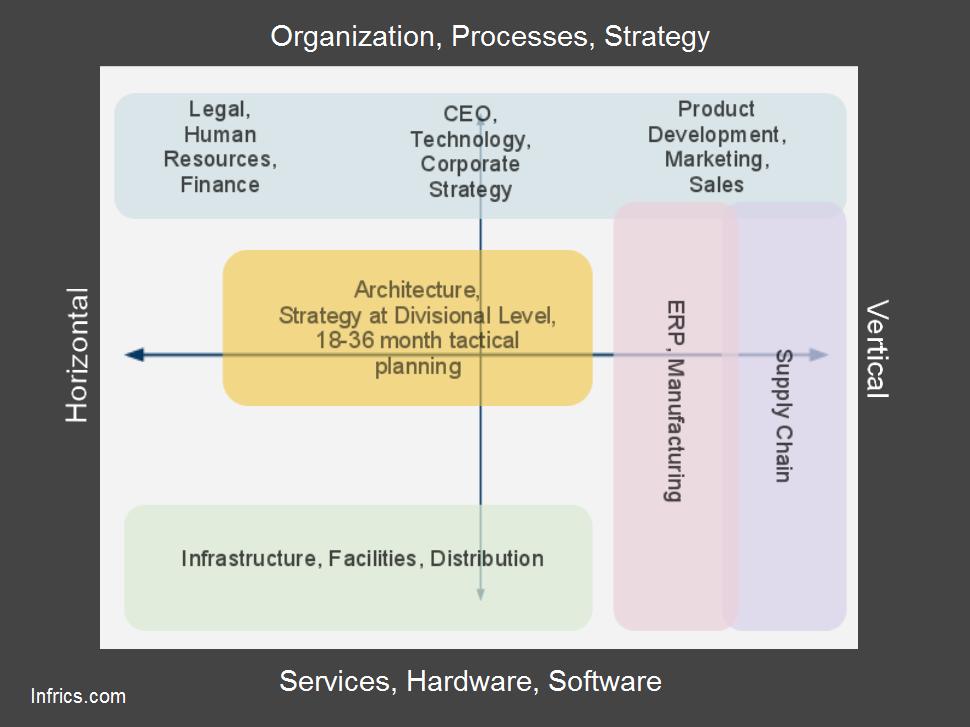
First, some level-setting: to understand the potential of services in business, we need to think of business processes and outcomes as either horizontal or vertical:

Look at this definition and this slide, from the Infrics analysis of research styles:
“Is the focus horizontal or vertical?  If many people come to you to solve a similar need across many departments, your focus is likely horizontal.  If you bring together people from many departments to achieve something that wouldn’t happen without that coordination, you’re more vertical.  “


What is a service?  Let’s try this on

Service: a means of delivering value, either through simplification and standardization of complex processes, or by abstracting complexity to the point that it appears simple to users, Services are primarily horizontal in nature; they can be reused and combined with other services to create primarily vertical outcomes.


What does that mean in practical terms?


  • Some services are consumed by other services (or processes), some are consumed by people (users.)
  • At each level, those consumers are spared the need to know how the service was supplied, they are freed to just use it to accomplish what they need.
  • In general, those services that represent simplification and standardization can be seen as plug-and-play building blocks, and represent the lower layers of the chart: infrastructure as service.
  • Services that mask complexity so that it appears more simple are enabled by those plug-and-play services lower in the stack.  Human resources, for instance, is a horizontal service composed of other services, and in turn delivered to vertical “run the business” efforts.
  • By virtue of their reusability, services reduce or eliminate duplication of effort, driving down costs.
  • By virtue of standardization--especially when they represent simplified business processes--services often lend themselves to competitive bidding and outsourcing.
  • Services tend to increase flexibility, and reduce deployment times, enabling greater agility from technology and business processes


We know services almost instinctively, because in areas outside of business and IT, we use them all the time.  The most classic example is electricity (thanks, Nicholas Carr); enormous complexities of generation and distribution are abstracted at the end user level. We have wires coming into our homes and a bill once a month.  Because electricity is standardized for voltage, frequency, installation codes, and connectors,  we can provision our entire home with simple, off-the-shelf appliances and lights, secure in the knowledge that it will all work.

Thinking of Power-as-a-Service shows two important ways to evaluate the value of service-oriented thinking, service KPIs, if you will:

  1. A good service disappears. You don’t have to be aware that it is there, you just get your work done or your problem solved.
  2. A good service enables DKDC--Don’t Know, Don’t Care.  I don’t know where the generators are that power my home, and I have no reason to care whether I know or not.

    When you think of services in enterprise and IT terms and consider the cloud computing discussion, the true test of cloud success would be DKDC; if I am the consumer of a cloud service, and don’t have to know or care that it
    is a cloud service, it’s performing as it should.  By their nature, services push the DKDC question to deeper and deeper levels, away from the consumer.  


“This means something. This is important.”  Roy Neary (Richard Dreyfuss) in “Close Encounters of the Third Kind.”  


Remember the big picture: 

  1. Simplify complexity where possible, push it down the stack away from users where needed, by decomposing technology delivery into reusable services--create a Service Oriented Enterprise. (subject of this series, A World of Services)
  2. Decouple the delivery of data and programs from specific devices, to allow users the ability to use technology without being limited by their machines.  Make delivery Stateless. (subject of the first of the big ideas articles, Free Your Machines, and Nothing But Net)
  3. Move direct power to manage information closer to the people who use it, and away from complex programming and projects.  Flatten organizations and make IT an invisible part of business processes. (articles in development now)
Next in A World of Services, "How technology disappears" Mapping services to business, describing IT services and the services-based IT organization, and thinking about innovation in the resulting low-inertia business environment.