Earlier this week, I posted a link to Appirio.com's blog post on the new "customer company" approach at Salesforce.com. Here is their own video explaining and celebrating the idea. Know more, in more places, and have ever-more-powerful choices. That's what the era of you is all about.
Showing posts with label Appirio. Show all posts
Showing posts with label Appirio. Show all posts
Saturday, March 9, 2013
Salesforce.com "customer company" video, more era-of-you in action
Earlier this week, I posted a link to Appirio.com's blog post on the new "customer company" approach at Salesforce.com. Here is their own video explaining and celebrating the idea. Know more, in more places, and have ever-more-powerful choices. That's what the era of you is all about.


Thursday, March 7, 2013
Personalization matters: three articles speak to the heart of "the era of you"
When I first started talking in 2011 about "the era of you" as one of the big ideas driving our tech and business future, I wrote:
"It’s partly about the way the internet and social networks are changing our sense of what a community means. It’s about the increasing ability of end users in enterprises to choose and deploy their own technology solutions. It’s about the flattening of power structures in business and the increasing power of consumers to interact with businesses. But none of these by itself expresses the big idea; each of these trends is a part of the bigger concept:
Technology is enabling individuals to know more, in more places and situations, and have increasingly powerful choices about the way they live and work. We are entering the era of you."
The era of you stakes are getting higher, reshaping business models and business strategy. Here are recent articles that drive the point home:
--from Fast Company
Why Companies Now Have to Romance the Same Customers They Once Bought
--from cloud integrator Appirio, on Salesforce.com
Salesforce’s shift in message is a recognition that consumers have more power than ever before in a connected world. No longer are they at the mercy of companies that treat them poorly; they have a loud, far-reaching voice with real power in the marketplace.
--from CIO.com
Gartner finds that CIOs now identify Customer Relationship Management (CRM) as their top IT spending priority
Finally, here is my report on what Disney's "Beauty and the Beast" can teach us about the power of technology. It can personalize business relationships and reintroduce the small village metaphor on the stage of the whole world:
We can now use technology to re-introduce highly personalized services that feel like village life in its most idealized form. Who will dream big enough to bring it to us? As Belle said, “there must be more than this provincial life.”
 |
| The era of you: a great idea revolutionized by 21st century technology Image from the Palm Springs Automobilist Facebook site |
"It’s partly about the way the internet and social networks are changing our sense of what a community means. It’s about the increasing ability of end users in enterprises to choose and deploy their own technology solutions. It’s about the flattening of power structures in business and the increasing power of consumers to interact with businesses. But none of these by itself expresses the big idea; each of these trends is a part of the bigger concept:
Technology is enabling individuals to know more, in more places and situations, and have increasingly powerful choices about the way they live and work. We are entering the era of you."
--from Fast Company
Why Companies Now Have to Romance the Same Customers They Once Bought
--from cloud integrator Appirio, on Salesforce.com
Salesforce’s shift in message is a recognition that consumers have more power than ever before in a connected world. No longer are they at the mercy of companies that treat them poorly; they have a loud, far-reaching voice with real power in the marketplace.
--from CIO.com
Gartner finds that CIOs now identify Customer Relationship Management (CRM) as their top IT spending priority
Finally, here is my report on what Disney's "Beauty and the Beast" can teach us about the power of technology. It can personalize business relationships and reintroduce the small village metaphor on the stage of the whole world:
We can now use technology to re-introduce highly personalized services that feel like village life in its most idealized form. Who will dream big enough to bring it to us? As Belle said, “there must be more than this provincial life.”
Thursday, April 5, 2012
The CIO of the Future: Conductor not Controller

The CIO of the Future: Conductor not Controller
Tuesday, November 22, 2011
The two-minute, user-created app: how Podio leads the era of you
--the first of two parts: an “era of you” Big Idea feature story
The ability of end users to choose and implement technology without technical skills, often without the need for a formal IT department, is central to one of the largest tech trends shaping the future. The ways we live and work--and the degree of personalization and individual choice we command as we do--are undergoing a revolution.
 |
| Podio's Ryan Nichols |
Innovative startups see this trend--the “era of you”--and are moving quickly to be a part of it. This story is about one of them, and a silicon valley veteran who is on the forefront.
Ryan Nichols can speak about emerging technology from a career across many enterprise tech worlds. Classic in silicon valley credentials, he is a Stanford business graduate, and directed the corporate strategy group at SAP. He was VP for marketing and product management at cloud integrator Appirio.com when we first met in early 2009 during an Appirio engagement at Avon. He blogs at ComputerWorld.
Today, Nichols looks at the way work is done and says, “there has to be a better way.” In September, Nichols joined Podio, a company that’s working to enable end users to be their own app creators, and offer the platform to deliver that “better way.”
The Copenhagen-based company exudes startup excitement and agility. Their U.S. office is in a downtown San Francisco tech co-officing loft space, an old brick two-story building with steel casement windows; somehow it escaped the wrecking ball as conventional office buildings loomed around it. There’s the ultimate tech-driven gestalt of jeans, rumpled dress shirts, open beams and brickwork, backed by the hum of people on a mission to make their fortunes while re-making the world.
On a blustery early November day in San Francisco, my meeting at Podio US involved a 20-something receptionist-for-the-whole-building waving me in, saying “Podio’s upstairs at the back left corner, the tables by the window,” picking my way through tables occupied by 10 or 12 other companies, and a short wait while Nichols returned from a meeting. There are no cubes, no offices per se, just a series of small conference rooms around the perimeter of the workspaces, with no sort of reservation system beyond “hey, is anyone using this room?” If you’ve ever trudged to work in a standard corporate IT cube farm, this is really heady stuff.
I’m in a modern, Aeron-style chair at a trestle table with three or four other Podio staff, a programmer intent on his laptop nearby. Like a lot of knowledge workers lately, for everyone in the building, their entire office is their laptop, tablet, smartphone, a backpack or messenger bag to carry them, and a WiFi connection. There are a few bigger monitors scattered here and there, a whiteboard or two, a dusting of sticky notes from a brainstorming session.
The “this is the very edge of innovation” feel is in stark contrast to my last meeting with Nichols, at Appirio’s San Mateo office in August, in a modern atrium office complex across a suburban boulevard from a shopping mall, all khakis and BMWs. As I would learn just a few days later, that August meeting was right before Nichols announced the move to Podio. There are two different startup vibes in the bay area now. As we’ll learn in the course of the conversation, even a very innovative company like Salesforce turns out to be one step behind the curve from a use-case and architecture perspective. Nichols told me, “I saw Appirio grow from 30 people to 300 people, and I was kind of itching to get back to 30, which is about where Podio is now.”
“When I saw what Podio was doing, building a very, very horizontal platform to help businesspeople develop their own apps that they really owned and fit the way that they wanted to get work done, that was pretty intriguing to me,” Nichols explained, “It seemed like a really fresh approach. In a world where there are a lot of online project management tools, a lot of online task management tools--the idea of creating a platform for people to create their own tools was pretty intriguing to me.”
Nichols says, “I sometimes describe Podio as “Excel meets Facebook.”
"Today, when you’re in that in-between space--you know it’s too structured to get done in e-mail, but there’s no application to support you--what you do a lot of the time is create an Excel spreadsheet with ten, twenty things on it, five columns, column number four is “who’s responsible,” and column number five is “comments.” And you e-mail it out to 10 people and you say “fill this out for me.” That ought to be an app. That’s a perfect use case for Podio. That’s something that’s “no developer required.” It’s as easy to build as an Excel spreadsheet, but when you’re done, it’s as engaging and interactive as Facebook.”
Here is a video from Podio demonstrating how users build their own apps:
Nichols says, “This is definitely one of those services where it’s “go to podio.com, enter your e-mail address, and you’re off and running.” You’ll have an app two minutes later, and you can make it your own two minutes after that, and then share it with your team two minutes after that.”
The platform is mobile-enabled automatically, with iOS and Android apps that allow users to log in and use their Podio applications with no custom programming.
Nichols tells the story of a small firm that took Podio’s platform and ran with it: “we had a swimming pool cleaning company in Kuwait that created an application to help them to manage groups of guys going out in vans to clean pools. There’s no commercial application to support the pool cleaning business, at least not one that’s any good.
So they created an app in Podio where there’s a pool app that keeps track of things like pH balance and depth and so forth, and a van app that keeps track of who’s in what van. Then, every time there’s an algae bloom in a particular pool, they have a little collaboration around “hey, let’s get the expert involved and figure out how to handle this.”
They built it and were using it on the web, which was fine, guys were bringing back their clipboards and recording everything back in Podio. When we released our iPhone app, it changed the game.
They deployed iPhones to all their drivers, and they automatically had their own mobile app, which is a pretty cool thing. For an organization that size, I think they have one IT contractor, no IT department essentially, to be creating their own mobile productivity app that they really run their business on is pretty cool.”
Podio has signed up 40,000 organizations. A Podio app store already lists 600 applications, arranged by horizontal uses like business development, marketing, or CRM and by vertical business needs like accounting, HR, and property management. More than 200,000 have been downloaded by Podio users.
But Nichols added, “app store is almost the wrong word. We call it an “app store” because people think app store is the place to get apps, which is exactly what it is. But today It’s not really a commercial environment; all the apps in the app store are free and a lot of them, an increasing number of them, are created by Podio users. We seeded it with apps that we created. Now, Podio users are sharing the apps that they’ve created, largely to do exactly that."
Podio is “a classic freemium model.” The first 10 users at a company are free, so is collaboration with anyone outside your company; Podio just announced that the platform will also be free to university students worldwide. Beyond that, “there’s a per-user, per-month charge for every employee you have using the Podio platform.”
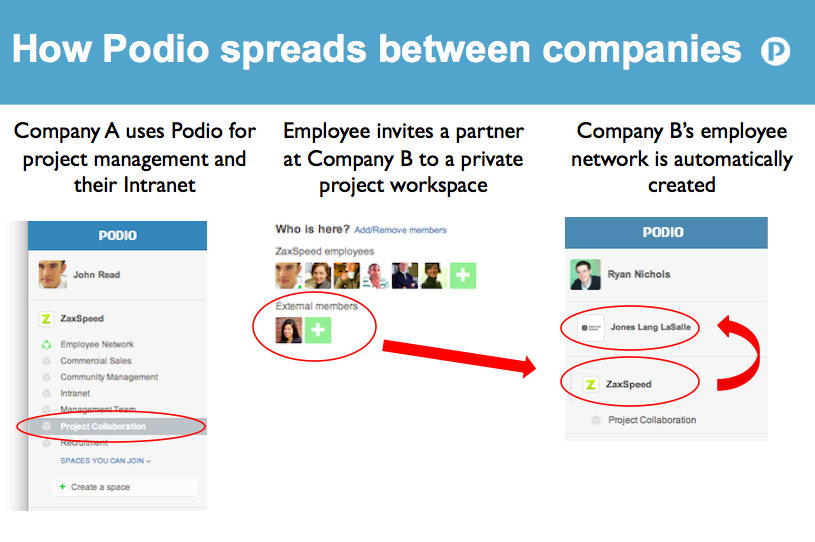
Podio reflects the “era of you” idea all the way to its data architecture, which, as Nichols explained, “has the user at the center of its data architecture, so “user” comes above “org,” which is the exact opposite of every other SaaS system out there--org is kind of the primary thing, and you almost had to do that, because at the time, the only way you could sell the concept of multi-tenancy to a buyer was to really emphasize the “tenant” part of that. Really emphasize the fact that everything was in a virtual container for your company. The buyers have matured enough to realize that there are other ways of providing security, and we can put the user at the center, and have users be part of multiple orgs. That’s an enormously powerful shift.”
Podio handles user and role security segregation, so users only have access to the things they have rights to. Nichols says, “It’s every bit as secure as the other model, but it gives us a whole bunch of flexibility. It’s just more usable to be in one environment and see all the different organizations that you work with, because we all work with different organizations.”
In this way, Podio has demonstrated one of the ways in which innovation happens; the idea of user-centricity needed deployed iterations of multi-tenant cloud computing to help the buyer community adapt to the concept and prepare them for a newer model. In the user-centered data and security model, it becomes much simpler for Podio to allow users to be part of networks with other Podio users.
What is the implication of the newer idea? “Podio can spread virally from company to company across business ecosystems, “ Nichols said, “that’s something that business software has never been able to do: spread virally across companies.” This is the sense in which a new company has seen beyond today's hot idea, cloud computing, and enabled a new kind of cloud-based innovation.
This screen shot shows what that looks like in practice:
As organizations evolve, as the community and social tools of the consumer space find their value expressions within companies and the life of work, we’re sure to find new value delivery opportunities. Among these will be much more flexible, repurposable work teams, and the rise of internal “free agents” who connect flexibly to multiple organizations, teams, and projects. That's the very model enabled by Podio's user-centric architecture.
There will be more “situational” tech deployments that arise quickly, serve a need, and disappear. Small businesses will have greater power to look and feel like very large ones, and very large companies may achieve levels of agility, personalization, and responsiveness that could make mom-and-pop operations jealous.
But all that implies a lot of challenges as well. Companies with legacy appllications and infrastructures, command and control organizational structures, and service delivery structures that are either not there or not fully realized all are positioned to run headlong into the changes that society and technology are advancing. For small and large businesses alike, a lot depends on how well they understand and act upon the big ideas, the changes at hand, especially the era of you.
In the second part of my discussion with Ryan Nichols, we examine those questions:
What happens when users won't play "Mother May I" with IT?
Subscribe to:
Posts (Atom)