Showing posts with label services. Show all posts

Monday, November 14, 2011

Wired Magazine interview with Jeff Bezos: Kindle Fire, taking the long view, and why Amazon is the opposite of Apple

Image from wired.com
Steven Levy, a senior writer at Wired magazine, just shared a preview of an upcoming feature on Amazon.com's Jeff Bezos.

Jeff Bezos Owns the Web in More Ways Than you Think

I admire a lot about Amazon, and this article is well worth reading; do you agree with Google's Eric Schmidt, who says the four most important tech companies are Google, Apple, Facebook, and Amazon?

Much of what Amazon.com does falls right in line with the big ideas I've been evangelizing here on infrics.com: back-end standardization to enable agile deployment of services, and server-based, device independent delivery of applications and content are leadership areas for Amazon.  Levy presents the idea, which I think is spot-on, that if Apple is post-PC, Amazon is post-web, "in which our devices are simply a means for us to directly connect with the goodies in someone’s data center."  

I follow Steven Levy on Google +

Tuesday, October 18, 2011

C-suite talk: can you make complexity disappear?


Building blocks, not jigsaw pieces.
Image from countingblocks.com

In the last of the C-suite articles, I talked about managing complexity, either by relentlessly simplifying processes and applications, or by abstracting a complex service in such a way that it appears simple to those who consume it.  This time, let’s take a closer look at the latter: how to use complexity abstraction and why it’s an underappreciated business tool.

A service oriented enterprise is composed of 4 service tiers (for more on service tiers, see “How Technology Disappears”):

  1. Lines of business, end users
  2. Service Orchestration
  3. Service Management
  4. Infrastructure
There are exceptions, but in general, the tiers build on one another: service management uses the products of the infrastructure service to enable service orchestration to serve end users. One of the simplest measurements of success at each level is the degree to which service providers can offer consumers freedom from concern over where the service came from and how it was provisioned. It just works.

This is not revolutionary, but it’s very actionable. By simplifying and standardizing component parts of complex things, the care taken by providers at each service tier abstracts the complex into a simple, consumable product.  How can you do this?

  • Standardize: practice strong, almost rigid exception management when customization is requested at lower service tiers.  This is an area, especially in IT, where businesses have traditionally operated backwards.  Your business and your employees are locked down to enable success of highly customized infrastructure and applications, when it should be exactly the other way: very high levels of standardization at lower levels in support of ease of deployment and customization at the user side.  If you are abstracting complex services by standardizing their component parts, you almost automatically guarantee your business is right-side-up here.
  • Reliability engineering: Attack the weakest link in a complex process, and do the heavy lifting required to get its reliability up. Think of your car engine: the ignition system and fuel delivery systems were once high-maintenance items that demanded a fairly high level of driver involvement. Today, both are handled by computers. The Bosch computer in my old car has now managed ignition and fuel injection without attention for 22 years. Reliability is a great complexity abstraction if you make it a component of service delivery.
  • Building blocks, not jigsaw puzzle pieces: each can be assembled into something useful, but jigsaws can only be assembled one way.  Building blocks are the ultimate abstraction, and can create many outcomes from standard shapes. That structure is the metaphor for your abstracted complexity.  If it only has one purpose, it it worth it?
  • Externalize: instead of creating abstraction inside your own four walls, pay someone else to do it for you, and purchase a consumable service, which appears simple to you as the consumer. This is the province of services like cloud computing, third party payroll managers, and distribution services like UPS.  Their success lies in managing away the complex so you don’t have to.  It’s their core business strength.  Is it really worth it to make it part of yours?  The greater core simplicity you can structure into your business--the areas that don’t justify customization or added complexity--the more opportunities this solution presents.  The explosive growth in enterprise-ready external services and their abilities is also moving favorably in your direction.


The idea is to create a virtuous circle: structuring for managed services enables simplification and abstraction of complexity, which enables greater agility and higher business efficiencies. It sets you up for “one question to rule them all,” namely, “do I have to care about where that service came from, or can I just put it to work?”

Tuesday, September 20, 2011

C-Suite talk: agility starts with 2 questions


C-Suite Talk: an Infrics.com series about ideas that matter to executives

Individuals--consumers of technology--move through rapid change like dancers. New ideas, new products, short implementation times and perpetual beta? Not only do they make it look easy, as former Texas governor Ann Richards joked about Ginger Rogers, they do it “backwards and in high heels.”

Corporations--enterprises--move like hikers with a 90-pound packpack. Burdened by legacy technology, the sheer size of their businesses, and business practices laden with feature creep, the best answer they can give to technology is often “not now,” and sometimes, it’s just plain “no.”

Without seeking to make light of the very real challenges of running a business, don’t you sometimes sit alone in your office contemplating your own business, and wish you were more of a dancer and less of a plodder?  If there is one single element that stands between you and agility as far as business is concerned, it’s complexity.  

Complexity sneaks in like a thief, but because it’s stealthy, it works its way through your processes and technologies until it begins to seem more like the norm than an unwelcome intruder.  Reducing complexity is strategic, but it takes a solid tactical mindset to achieve. As you tackle complexity in your organization, try looking at it by asking these 2 questions:  
Is there a simpler way to do this?


If not, how can we manage the complexity so that it appears simple to those who use it?


Images from wikipedia.org


These are hardly revolutionary ideas. But the thought of seeing complexity through two different lenses is a powerful one that can be used in a lot of situations.  One can build on the other.  Can you simplify underlying processes as a means of abstracting a more complex one?  Can an abstracted complex process enable a simpler approach in another area? 


When you either reduce or abstract the complex, you service-enable it; the components of your technology and your business become building blocks. It is not realistic to think you can eliminate the complex, but it is a critical business success factor that you manage it.  

Complexity management is the business equivalent of laying aside the backpack, and walking on level ground instead of uphill all the time.  It is a core concept of the service oriented enterprise, and is a core tool for the C-Suite to manage enterprises well.

Monday, August 1, 2011

How Technology Disappears: Part 2 of "A World of Services"

Thinking of technology delivery as an expression of services is a big idea.  Services help technology in business disappear.   
Cheshire Cat image from victorianweb.org

Why is this important?  What’s the payoff?

  1. Agility: The holy grail of business technology is to get to value more quickly.  Services move IT toward plug-and-play, and away from custom-tailored, take-forever-to-deploy solutions.
  2. Cost: standardize, externalize, gain economies of scale. Spend time and money on the things that make you competitive.
  3. Services are a foundational part of the move to stateless devices.  “Your-business-as-a-service” is a perfect match for “any device/any time/anywhere.”
  4. Services are foundational as part of moving decision-making about technology away from those who provide it (the traditional IT department) and toward those who use it.
As we focus on what that means as a trend, let’s examine the idea of services and think of them as part of the future of business.  

Service definition 1: simplify and standardize complex processes

Building a house is a good example of simplified services. Doors and windows are simplified and built to standard sizes.  You can buy what you need off the shelf and install it without customization, secure in the knowledge that it will fit and meet regulatory codes.  Because it was manufactured in large quantities in a standardized way, economies of scale make it much less expensive than a custom-made equivalent.  In exchange, you accept the range of sizes, styles, and colors, and design the house to accept the standards.

In business, most IT functions labeled “-as-a-service” are built on a model like this; users accept some standardization and buy the service as offered.  But that doesn’t fit for every business need, especially when the legacy technology grew up around ever-increasing levels of customization and complexity.  Which leads to:

Service definition 2: abstract complexity

Frankly, some parts of business are complex, and there is no magical way around it.  Even if you overcome the change management issues around greater simplicity of business processes, there are still regulatory and legal complexities that cannot be avoided. There are some complexities that deliver competitive value. But there are ways to abstract that complexity and mask it so that it appears simple. Someone has to manage complexity, but they can deliver it in such a way that those who use the service neither know nor care what is going on behind the scenes.

For an example of this, look to your car.  In the last 25 years, something remarkable has happened to automobiles.  Engines and transmissions, even in inexpensive cars, have growth dramatically more complex than before: turbochargers (sometimes 2 of them), multiple valves per cylinder, with continuously variable valve timing. Direct injection of fuel, electronic automatic transmissions with up to 8 speeds--all controlled by a computer system more powerful than mainframes of the recent past.  

It’s all abstracted from the driver. Start the car and it goes, without you having to care about a single one of those technological marvels.  Furthermore, during the 100,000 mile warranty period, the only maintenance required is fluid and filter changes.  Most of the engine is shrouded in molded plastic, looking more like a plug-in module than a piece of machinery.  Motive power as a service.  

The technology disappears, the benefit is what’s consumed.  

That’s the model current businesses and their IT departments can aspire to as a means of managing the complexity that can’t be eliminated.  The central questions

  1. Does this have to be complex? Is this a complexity of heritage process or legacy technology that is not needed?  Is it a worthwhile tradeoff to lose some customization to gain agility and lower cost? If so, you can move to the “simplify service” route.  Classic examples, standard office applications like word processing and e-mail.  
  2. Is this complexity that adds value, or is unavoidable for structural reasons, such as regulatory compliance?  If so,  the goal would be to abstract that complexity away from processes or people who use it, so that to them it appears simple.  For each complex service, ask question 1 again: are there components of this complexity I can simplify to make the abstraction process faster, easier, cheaper.

If you have succeeded, the result will be “building blocks” for technology and business processes, standard-appearing components.  They can be consumed--used as-is--or recombined to create other services.  

A hallmark of service orientation: those who provide a service know and care about the way it is provided, those who consume it don’t have to: DKDC (don’t know, don’t care.)  As service orientation spreads through IT and a company, DKDC spreads downward from the top, while power to deploy technology and combine services spreads upward toward users.

Service delivery starts with the end user, and works back until it reaches infrastructure. At the top, the main deliverable is “IT as a service.” That service is itself composed of individual and federated services.  This chart shows what that would look like:


The lower levels are foundational for those above. The Service Management level and Service Federation levels represent what I believe to be the future of IT within companies:

  • Definition and management of services becomes a central role, highly technical and specialized positions in the organization tend to be externally sourced as individual service components or packaged as third party services. Internal skills include high levels of focus on service contracts and service level agreements.  The orchestration of services and the management of quality of service delivery take on new importance.
  • Business applications are delivered as a service, either directly by a cloud vendor, as composite applications created in-house through federation of other services, or as legacy applications delivered through desktop virtualization.  
  • At the Delivery level, the close tie-in with stateless computing shows its value.  The entire “business as a service” experience is delivered through a web interface, and IT gets out of the user device management business.  
  • Key vertical roles within the services organization are the technology architect, who works across the various disciplines on service design, integration, and delivery; and the business technology analyst, a main point of contact between top-level service consumers--the users and the business departments--and the various service delivery teams.  But note, DKDC even extends to this level of consumer; if infrastructure-level services are deployed correctly, the analyst does not need to know or care how they are delivered.  

When technology disappears, information technology will have grown up; delivery of business capabilities through services is how that happens.

Next in the Big Ideas series, we’ll look at how stateless computing and a world of services become success triggers for the third major idea: flattening of organizations, and the movement of tech power ever closer to those who use it.

Friday, July 22, 2011

Tell me where it hurts: part 1 of "A World of Services"


Think about where it hurts when you consider the current state of technology in business:


"I'll need a business case, an ROI analysis, approval from legal
and finance, a project manager, FTEs, and
a development environment in three minutes, or we're all dead!"
  • Business technology seems moribund; it takes forever and costs too much to do things you can do easily in the consumer technology world.
  • CIOs would like to see themselves as Mr. Spock to the CEO’s Captain Kirk: a trusted consultant who comes up with the right solution, standing by the captain bravely staring into the future.  In practice, IT is often more like Mr. Scott in engineering, asked to perform the impossible with astoundingly complex machines, scrambling to save the day. When Kirk said, “Mr. Scott, I need warp speed in three minutes or we’re all dead!” Commander Scott always came through.  Unfortunately, CIOs don’t have scriptwriters on their side.
  • Needless to say, if the fictional USS Enterprise operated like the enterprises we serve every day, it would have fallen out of the sky very early in the first season. There has to be a better way.

People have dreamed of a streamlined, responsive IT and a truly agile business for a very long time.  Enter the idea of services.

Web services. Service Oriented Architecture. Cloud services. Software as a Service. Middleware-aaS. Platform-aaS. Infrastructure-aaS.

Decompose technology delivery into manageable services. 
 
“Service” is a veritable workhorse of an IT word. Append it to anything and like magic it sounds current and desirable.  The challenge with such words is that sometimes, they are important, but get lost in the buzzword sea.

That’s my point. The idea of services in business--IT especially-is one of the keys to understanding the future.  Embracing the services idea actually
does have promise to improve things.  We can look more closely to find out why.  

One common theme at Infrics.com is that there is a bigger story about technology, business, and society than we see when we're head-down, working on tasks and projects. There are many reports and many companies who will help you do the head-down work; legions of dedicated people are giving their careers to those endeavors. This is about the other part: looking for themes within the big story that may help us do things better.  The idea of services in that big picture isn't sexy, and it's not all that buzzword-friendly. but I contend that it's worth examining.

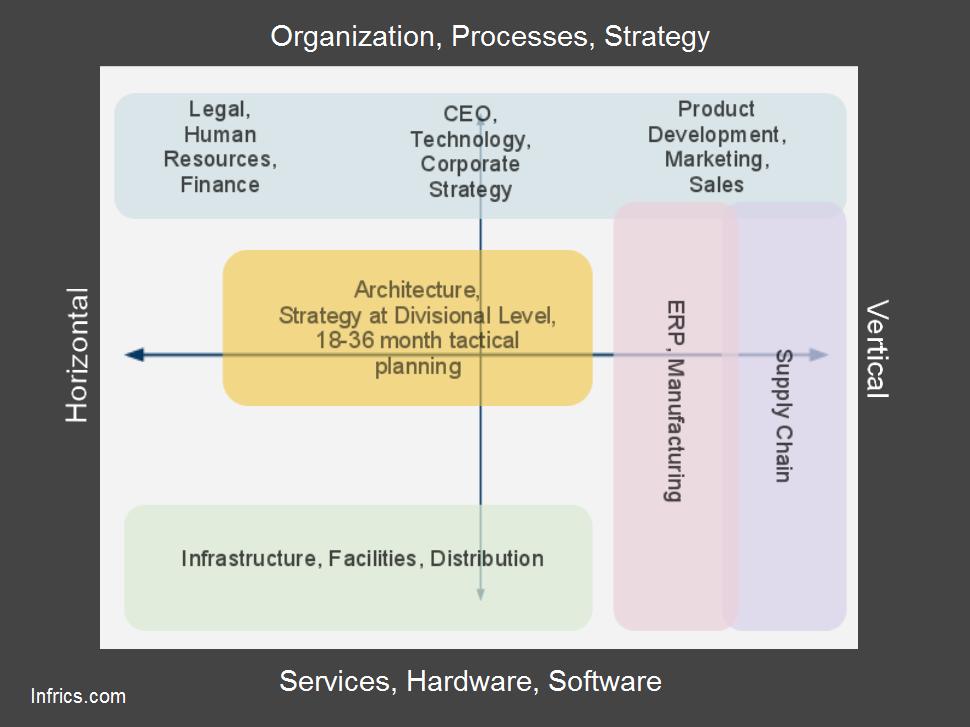
First, some level-setting: to understand the potential of services in business, we need to think of business processes and outcomes as either horizontal or vertical:

Look at this definition and this slide, from the Infrics analysis of research styles:
“Is the focus horizontal or vertical?  If many people come to you to solve a similar need across many departments, your focus is likely horizontal.  If you bring together people from many departments to achieve something that wouldn’t happen without that coordination, you’re more vertical.  “


What is a service?  Let’s try this on

Service: a means of delivering value, either through simplification and standardization of complex processes, or by abstracting complexity to the point that it appears simple to users, Services are primarily horizontal in nature; they can be reused and combined with other services to create primarily vertical outcomes.


What does that mean in practical terms?


  • Some services are consumed by other services (or processes), some are consumed by people (users.)
  • At each level, those consumers are spared the need to know how the service was supplied, they are freed to just use it to accomplish what they need.
  • In general, those services that represent simplification and standardization can be seen as plug-and-play building blocks, and represent the lower layers of the chart: infrastructure as service.
  • Services that mask complexity so that it appears more simple are enabled by those plug-and-play services lower in the stack.  Human resources, for instance, is a horizontal service composed of other services, and in turn delivered to vertical “run the business” efforts.
  • By virtue of their reusability, services reduce or eliminate duplication of effort, driving down costs.
  • By virtue of standardization--especially when they represent simplified business processes--services often lend themselves to competitive bidding and outsourcing.
  • Services tend to increase flexibility, and reduce deployment times, enabling greater agility from technology and business processes


We know services almost instinctively, because in areas outside of business and IT, we use them all the time.  The most classic example is electricity (thanks, Nicholas Carr); enormous complexities of generation and distribution are abstracted at the end user level. We have wires coming into our homes and a bill once a month.  Because electricity is standardized for voltage, frequency, installation codes, and connectors,  we can provision our entire home with simple, off-the-shelf appliances and lights, secure in the knowledge that it will all work.

Thinking of Power-as-a-Service shows two important ways to evaluate the value of service-oriented thinking, service KPIs, if you will:

  1. A good service disappears. You don’t have to be aware that it is there, you just get your work done or your problem solved.
  2. A good service enables DKDC--Don’t Know, Don’t Care.  I don’t know where the generators are that power my home, and I have no reason to care whether I know or not.

    When you think of services in enterprise and IT terms and consider the cloud computing discussion, the true test of cloud success would be DKDC; if I am the consumer of a cloud service, and don’t have to know or care that it
    is a cloud service, it’s performing as it should.  By their nature, services push the DKDC question to deeper and deeper levels, away from the consumer.  


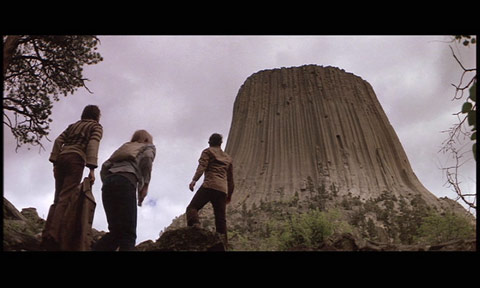
“This means something. This is important.”  Roy Neary (Richard Dreyfuss) in “Close Encounters of the Third Kind.”  


Remember the big picture: 

  1. Simplify complexity where possible, push it down the stack away from users where needed, by decomposing technology delivery into reusable services--create a Service Oriented Enterprise. (subject of this series, A World of Services)
  2. Decouple the delivery of data and programs from specific devices, to allow users the ability to use technology without being limited by their machines.  Make delivery Stateless. (subject of the first of the big ideas articles, Free Your Machines, and Nothing But Net)
  3. Move direct power to manage information closer to the people who use it, and away from complex programming and projects.  Flatten organizations and make IT an invisible part of business processes. (articles in development now)
Next in A World of Services, "How technology disappears" Mapping services to business, describing IT services and the services-based IT organization, and thinking about innovation in the resulting low-inertia business environment. 

Thursday, June 9, 2011

Excerpt from the upcoming "A World of Services"

I'm in the process of writing part 2 of the "Big Ideas" series.  Part 1, about the role stateless devices will play, is here.  Right now, I wanted to share this pre-publication excerpt from the next installment, which lays out the central points about "services," which I believe reflect current events, and promise great things:

"What qualifies the idea of services to occupy such an important spot?  Partly, it reflects what is happening in technology; “X-as-a-service” (XaaS) ranks right up there with “cloud” in the buzzword lexicon in 2011.  Cloud itself is an expression of services.  Like “web services,” one of the earlier expressions of the idea, services are powerful because they are simple and reusable.

In addition, business in general and IT in particular are cumbersome, slow-moving, and burdened by a heritage of extensive customization.  It costs too much, it takes too many layers of organization to plan, execute, and run.  In the case of the IT division, that burden has created the reputation of “IT as the people who say no.”  Services promise the chance to change all that for the better.  

This article will make the case that much of that customization can be cast aside where it is no longer helpful, and that a services-based organization will allow for a much easier--and much greater--level of customization in the right place, where it can offer genuine business value.

For both technology and business, we can think of services as:

A series of primarily horizontal processes, designed so they can be assembled to create a primarily vertical outcome


Conversely, if you can find a horizontal process that only serves one outcome, by definition, that takes it out of the range of useful services. One of the value markers for a service is the extent to which it serves many different processes."