Showing posts with label itunes. Show all posts

Thursday, July 19, 2012

iTunes, Google Play, Amazon: digital ecosystems fail the stateless future, digital content IAM offers opportunity, hope

As John Battelle pointed out in his own blog post a few days ago about the Google Nexus 7 tablet, the company you choose for your digital ecosystem matters.  How we pay for, manage, and consume content is becoming more and more important.  That's because content--words, audio, video, and applications--represents the sentinel trend of the entire stateless revolution.  Content is digital, stored in the cloud, and separated (or decoupled) from the delivery mechanism and the way you consume it. 

In a pure version of this, you would pay for a license for the creative part, and then own it.  You would decide where it would be stored, how and when it would be delivered to you, and on what device you consumed it.

My own Nexus 7 arrived a couple of days ago.  As reported all over the web, it's optimized as a consumption device for the offerings of Google Play, their digital ecosystem of books, magazines, music, movies, and TV.  This is hardly a radical idea.  The iOS/iTunes pairing and the Amazon Kindle Fire are also designed toward the same goal; each claims to offer a complete one-stop answer for all your media purchase, storage, and consumption needs.
Content bound to media: how quaint
image from freedigitalphotos.net

What doesn't get mentioned often is just how carefully each is designed to make sure you don't get or consume content from the competitors.  That's the business model: create a single point of contact for digital media, keep it inside your own four walls, and sell it as a package.  Alas for big companies, that's the big-box retail model brought to the web, isn't it? As a consumer, you trade convenience for lock-in and more limited choice.

In that way, the business models from each company work directly against your own increasing ability to own and control your own content.  At the same time, across almost everything we see in technology, the real trend is toward personalization, more specialized choice, and the movement of tech power further away from big companies and ever closer to the end user.  

When you think about digital ecosystems as part of a business plan, rather than a reflection of where society and technology are taking us, there is a disconnect.  Where there is a disconnect, there is a need and a possibility.  Where there is a need, there is a business opportunity, and the likelihood of disruption.

 Later in this article, I'll introduce the idea of externalizing that control with Digital Content Identity and Access Management, and offer ideas about the way that one change may profoundly alter the way we think of digital ecosystems.

Historically, the physical manifestation of art--words, sounds, images--was bound to the thing that brought that content to you.  It could have been words on the page of a magazine or a book, or the tracks on an LP or CD.  When you paid for the physical thing, you bought a license for the artistic part at the same time.

The core of the stateless idea is that each of those elements is decoupled from the others; data and applications are cloud-delivered, and consumed on a machine designed to deliver a user interface and a connection to the cloud content.  The inevitable trend is toward separation of content from delivery mechanism from consumption mechanism.   So what happens to the license, your payment for the true worth of a book, a song, or a movie?  For the most part, when you become part of a digital ecosystem, it is still bound to the delivery mechanism, and your newfound digital freedom has been limited.

There is no iTunes app for Android, for instance.  You can "own" streaming movies through Amazon, but you can only access them through the video player on Amazon's website, which is Flash-only, therefore off-limits for iOS and my new Nexus tablet, which is Android Jellybean and also not Flash-enabled.  Digital books from Amazon are linked to their own Kindle device--and even though you've paid for a Kindle book, you can't loan it to anyone the way you could with a physical book (correction: shortly after I published the story, a reader let me know that you can, in fact, loan a Kindle book on a one-time basis to another reader. I think that is good news.)

Google Play is somewhat less controlled, but it's still a "four-walls" kind of thing.  Buy a song from Google, where do you have to manage it?  Yup. If any of these sites goes down, do you have rights to access a licensed copy of your content somewhere else?  No.  If your account is hacked, who do you have to go through to regain access to your content?  The ecosystem.  I think you see the point.  As things stand now, you only own content you buy if you play by the rules of the company that sold it to you. 

It's as if, 25 years ago, you bought a Fleetwood Mac CD from a Virgin Megastore, could only store it in their proprietary CD case, and only play it on a Virgin player.  I exaggerate, of course, but the point is, we have all gained one freedom--online access to our stuff--by trading control of it to the company we choose for that digital ecosystem.

The promise of stateless digital content is unfulfilled.  If ever there was an area facing a perfect storm of technology change, new user expectations, and old business ideas fighting to stay alive, this is the place.

What is the opportunity?  Digital content identity and access management (DCIAM) 

As part of your online identity, this company will--once it exists--maintain a database of all the digital rights you own, authenticate you as the rightful owner, and verify you as licensed owner of cloud-sourced digital content.  Accessible as a universal web service, and independent of any ecosystem, this is a not only a logical outcome of the move to stateless, it is a huge enabling technology for:

  • Further disintermediation of traditional media companies, as independent artists' reward system would move outside the media companies' control.  If you are a media company, it is now in your interest to make sure your product can be sold in the widest-possible range of locations, because what you are selling is just the license, now handled by a trusted third party.  If your business model is based on artificially high prices based on forced linkage between content, delivery, and consumption, that model will be in significant danger.  
  • New sales models, in essence re-enabling in digital format the old megastore idea, in which you could pay for a license for any content from any publisher or creator.  As the consumer, you would no longer be hindered by the fact that your ecosystem vendor does not have sales agreements with every source.
      
  • New digital content storage, management, and delivery vendors, who maintain libraries of content in common, and follow the cloud shared tenancy model to supply you with your content via DCIAM authentication.  Any device, any time.  If one vendor is down, DCIAM eliminates barriers to your access through another source.
  • New ultra-personalized "stations" combining delivery of your own licensed content with new content paid for via advertising or subscription.  I've already written about this idea as applied to Pandora.com, in which Pandora saves broadcast license fees by subtracting them from any content they play you that you already own.  If I paid for "Go Your Own Way" by Fleetwood Mac when I bought rights to the "Rumours" album, there is no longer any reason why Pandora should pay BMI or ASCAP if they stream it to me.  DCIAM makes granular song-by-song licensing not only possible, but powerful.

    Using DCIAM, the same model might further the distruption of the traditional video network concept and the cable/satellite industry.  We are already seeing a big consumer push toward a-la-carte TV; DCIAM can push that further toward the consumer.  If Pandora can deliver me a personalized audio experience of female jazz singers from the 50s, there is no logical reason why I can't get my own cooking channel on TV, assembling the best shows currently on the Food Network, Bravo, PBS, and the Travel Channel.  DCIAM would also manage one-time use licenses, such as for a TV show, either via purchase or paid by acceptance of advertising.  This is essentially a new network model, not of broadcasting, but of extreme narrowcasting.  DCIAM enables the business model.
     
  • Handled properly, the marketing opportunities presented by one common database of a consumer's taste and purchasing history for content can use DCIAM to radically personalize ad delivery in cases where content consumption is still ad-supported.  Ad personalization is still wildly fragmented, and largely because information about purchases and interests is localized to the sites that control the ecosystem.  Once that is externalized, those barriers are gone.  This is "era of you" personalization brought home in the form of a huge business opportunity.  If digital ecosystems are the sentinel of the stateless future, digital ad personalization is that sentinel's entrepreneurial cousin.

Technology triggers are in action here.  Changes in what is possible--stateless licensing, content, delivery, and consumption--mean that opportunity is near for a company who moves beyond the current digital ecosystem model.  In so doing, they access business opportunities that make current ecosystem efforts look miserly by comparison.  

Combine DCIAM with the upcoming revolution in digital personal assistants, and you begin to see the true battle of the giants for your loyalty in the near future.  

There are big questions.  Who will bring this to you?  Who will still be a significant vendor in 5 years? Who will you trust?

Infrics.com articles referenced in this report:


Don screams into his laptop at Pandora.com.  Computer says no.

Thursday, September 8, 2011

Who owns your music, video, and books? The stateless revolution comes to the world of content and media


Cassette, it's all your fault.
 Image from rpmdesignfactory.com

Think of the word "media." We toss it around to refer to the music we hear, the movies and TV we watch, the words we read in books and newspapers.  But "media" is actually that which that carries the thing we consume--the content.  Historically, that was never an issue; you paid for the "paper," which represented both the physical newsprint you carried away from the newsstand and the content printed on the paper.  You bought the CD, a physical piece of plastic, tightly bound to the music it contained.  The delivery mechanism and the content were unbreakably linked. You knew you owned the content, because you owned the thing that carried it.  Life was simpler.

Although in some ways it seems that the “who owns the rights to content” question is becoming more strident, it reflects changes in society and technology over the last 50 years.  Audio and video cassettes gave us portability and time-shifting.  CDs and DVDs introduced digitization of media, and broadband networks gave us ever-increasing ways to purchase, access, and share that digital content.

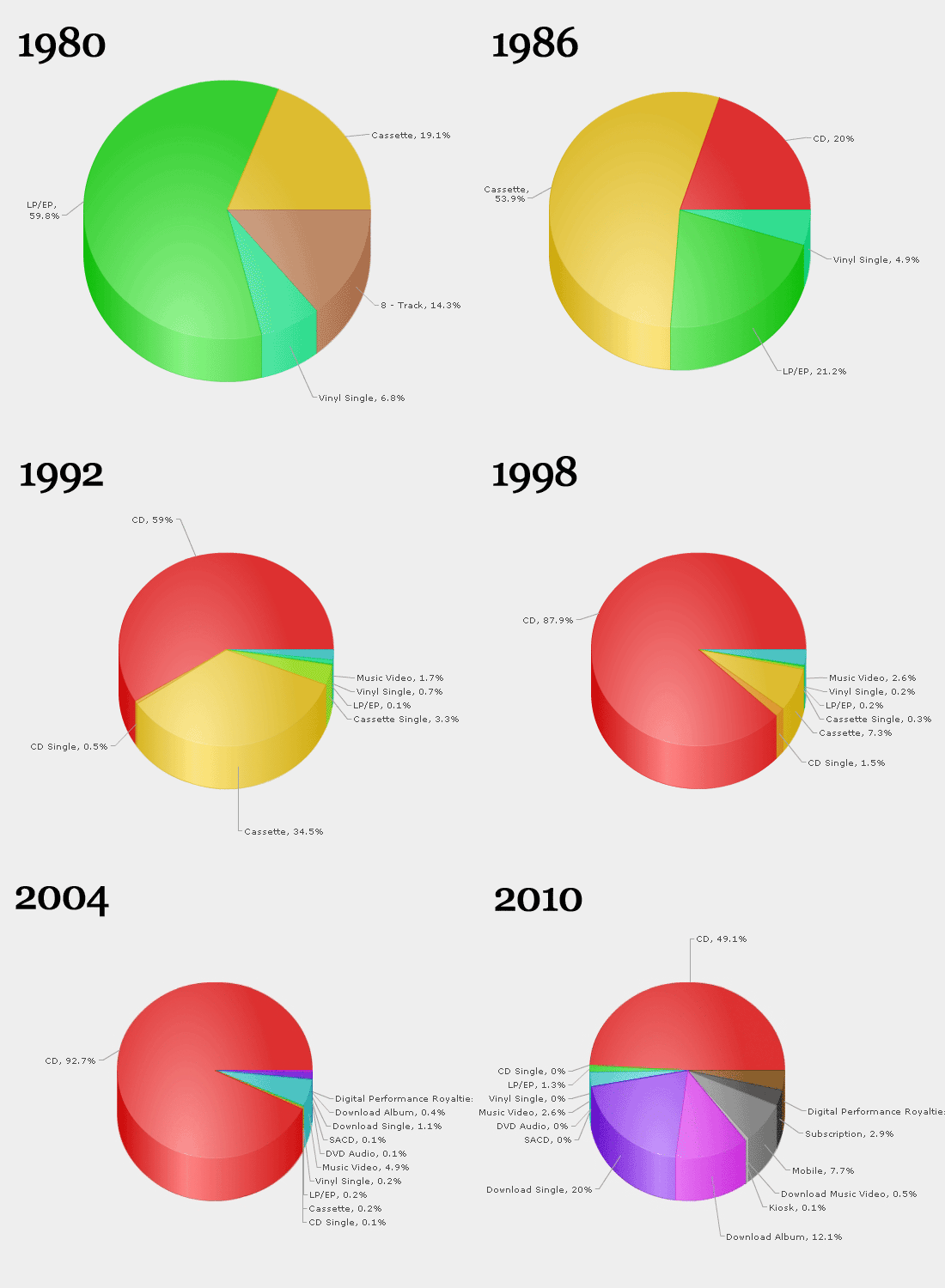
This is what happened to the purchase of music between the cassette era and now:


The CD was so seductive: 3 times the price of a cassette or an LP,
in its heyday it was a license to print money.
But it was doomed by broadband and online distribution
--when content became stateless.

Technology can now break the ties between ownership, delivery, and consumption of content.  Content has become stateless. It is a service, not a thing.


The idea of stateless computing--that the content and applications we use every day should be decoupled from the devices we use to consume them--is one of the infrics.com “Big Ideas.”   A book is no longer a physical thing you purchase and own as a "thing," it's a service you buy, and the physical "book" is just a manifestation of what you purchased.  Stated that way, it's simply a reflection of the entire stateless/services concept.  When you combine stateless content with the web and browser-centric operating systems like Google’s Chrome OS or virtualization of conventional desktops, applications themselves become part of the question. They do not reside in, nor depend on, a specific piece of equipment in order to provide their value.

An online friend posted a link to an insightful article from Technology Review, MIT's magazine of technology innovation: A Cloud Over Ownership.  The article opens with this statement:

"Online services set content free from the physical world's constraints—including those that have defined the very idea of possession."

I believe this is a major trend;  not only does it express societal and technological versions of the stateless and services-oriented future,  I further believe that it is inevitable.  There are business models fighting to preserve the old ties between content and consumption, but the writing is on the wall for their future. Businesses that seek to delay the inevitable will pay a high price; those who understand this future and take advantage of it will profit very handsomely.

Since ownership, delivery, and consumption of content have been rent asunder, let’s consider the implications for each:


WinnersLosers
Ownership
Sales of content rights and management of those rights across differing consumption mechanisms has a big future.

RIghts aggregators and managers represent a new market opportunity.

With granular rights management, any online music service would be freed of license costs when it streams me a song already in my personal library of purchased content. Same for any granular management of rights for already-purchased content--video, software, books, periodicals.
Any (read most) media or software company whose business model depends on you paying a premium for content based on their control of that content’s delivery and consumption mechanism

Delivery
A la carte content, managed at a granular level, changes the whole idea of "broadcasting." The “mass media” idea central to broadcasting does not go away, but the need for a specific delivery vehicle--like a TV station or a cable company--does.

Supplying broadband IP connections, and management of those connections across many different access points and technologies, is big and will get much bigger.
Once content is separated from the means of delivery, the business model for cable and satellite TV companies is meaningless, although they could survive as IP network providers.

For all practical purposes, so are the business models of local TV and radio beyond their role in creating purely local shows.  
Consumption
Things get very interesting when you talk about decoupling content from the devices traditionally used to license purchase and limit ownership rights.

Content/consumption-linked business models (books, CDs and DVDs) will be increasingly challenged by stateless content ownership (digital purchase such as iTunes and Amazon)
Digital delivery storefronts: iTunes, Amazon.com, hulu

Sirius/XM for their content & web delivery, and as an IP-via-satellite content delivery network
RIAA and MPAA, who have invested heavily in trying to preserve outdated license models.  If they can position themselves as the way to make stateless content licensing work for artists AND users, they could have a bright future; otherwise they are likely to be disintermediated out of existence.

ASCAP/BMI, who will have to restructure their licensing models to include management of individual ownership rights in addition to broadcast-linked agreements

Sirius/XM for their one-license-per-tuner model


Action Items:

  1. If you’re a business, your future software license models should reflect this trend: licensing of users, not devices.  Be prepared to negotiate the difference between differential pricing for one-time or limited-time use and for ownership.
  2. For content purchasers, be mindful where the technology you use is heavily biased toward maintaining old profit models: proprietary formats for content (iTunes, Amazon Kindle for books, for example) are built to lock content, delivery, and devices together.
  3. Emerging purchase models are struggling to break free of legal restrictions and old business models.  The future favors hulu, Amazon Video, Pandora, Spotify over traditional networks.  
  4. Watch for prices to drop and flexibility to increase from traditional video content bundlers like Comcast and DirecTV; if they adopt a la carte channel purchases, they may survive. However, their “pay a lot for 350 channels, of which you watch 10” model is in serious trouble.  They built their business on being the only way for you to access content; that isn’t true today.
  5. Conversely, network providers like Bravo and CBS will soon learn they are losing audience to people who no longer consume content the way they have been licensing it; you should soon have the ability to buy and receive any network directly over the internet.  
  6. Your rights as a consumer are not fully realized yet, but they have been expressed, as the Digital Consumer’s Bill of Rights.  Although the site has gone inactive, its founder, Graham Specer, blogs here.
When I began writing this article, I was full of righteous indignation about my rights as a consumer of content, and the ways the market has tried to withhold them; but in fact, that's beside the point and unnecessary.  


Business will act to preserve its profits, but it will also have to deal with its own failures to pay attention to the future. The rights of users to buy content separately from its delivery and consumption will happen because ultimately, that's the business model we will purchase from. Whether the new model is delivered by an existing entity that evolves or by a new company that puts them out of business is still up for grabs.

I will say that as the people who will be paying for all that music, video, words, and applications, it's incumbent on us to understand how these new rules change the game, and demand whenever possible that our vendors acknowledge that. The more people who use Hulu Plus and say no to their cable company, the faster the inevitable will be here, and the better for both business and consumers alike. What do you think?